
Shruti Bhat PhD, MBA, Operations Excellence Expert
  • Home
  • Shruti
  • Operational Excellence Hub
  • OpEx Models
  • Writings
    • Process Improvement
    • Business Transformation
    • Innovation Management
    • Leading Research and Development
    • Developer's Diary
    • Business Continuity
    • Change Management
    • Digital Transformation
    • Quality Improvement and Compliance
    • Free eBooks and Whitepapers
    • Checklists and Templates
  • Books
  • Services
    • PharmaOps Consulting
    • Tara LeanWorks
    • Training Services
  • Blog
  • Insights
  • Case Studies
  • Patents
  • Print Publications
  • Videos
  • Contact

What is Strategic Decision-Making?

10/21/2022

0 Comments

 
what is strategic decision -making
When you're in charge of making decisions for your business, you need to think strategically and act accordingly. 

Strategic decision-making requires improvised business strategies and collective strategies to ensure the success of a business. It also requires the consideration of corporate inflection points and cross-business synergies. Listed below are some tips to help you make the best decisions for your business. Hopefully, you'll find these tips helpful.

Plan for change
Strategic decision-making is a process of laying out an overall direction based on a larger vision and long-term goals. By identifying big-picture aims, you'll be able to align short-term plans with your mission and vision. When you map out the strategic path, you'll have quantifiable milestones to measure and track against the overall vision. Then you can make short-term decisions to achieve these milestones.

A key part of strategic decision-making is making sure everyone is involved. While some participation in strategic decision-making may be explicit and voluntary, others may not feel included or have any real influence. But, regardless of how much participation you want to involve in your plan, it will be crucial to determine key performance indicators for your company and set priorities that are consistent with these objectives.

Plan for risk
Organizations must be agile to respond to the changing business environment and planning for risk is a crucial part of this process. In an era of regulatory change, economic volatility, and digital disruption, risk control must be embedded into strategic decision-making. This enables business leaders to plan for risk, improve the agility of their business decisions, and create a culture of risk management. They can assess strategic implications and plan for different types of risks.

Before implementing any strategy or risk management process, it's important to define the objectives. Once these are determined, a risk management group should develop a consensus view of the risks to be managed and record this view on a risk map. Identifying key risks and the associated action plans, if any, will ensure that the strategic decision is properly implemented. Once this is complete, the group can designate an "owner" for each major risk.
​
Listen to options
While many believe that major strategic decisions take place in environments with high validation, a published paper on RPD decision model suggests that most decisions do not take place in such a high-validity environment. Instead, executives follow their intuitions and run mental simulations to explore various options. It is an effective way to gain insight into what you really want. This approach of decision-making can be highly effective in many situations especially during a crisis or when data for decision-making is insufficient.
How fast a decision is made and how good is that decision determines how far the business will thrive.
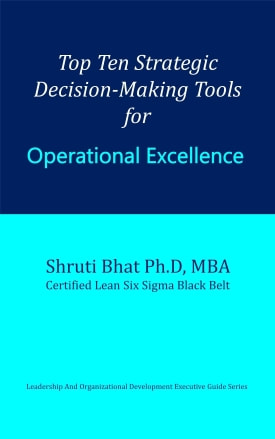
Checkout- Top Ten Strategic Decision-Making Tools for Operational Excellence

​
Related Reading:​
  1. Kaizen for pharmaceutical, medical device and biotech industries
  2. How to cut costs strategically using Kaizen
  3. Streamline processes and workflows with Gemba Walk.
  4. Top Ten Strategic Decision-Making Tools for Operational Excellence


Follow Shruti on Twitter, Facebook, YouTube, LinkedIn

Categories:  Strategy | Leadership

Keywords and Tags:
#operationalexcellence #strategicdecisionmaking #strategy #strategymanagement #decisiontools #decisionmaking #strategicplanning  #challengesofdecisionmaking
Get In Touch
0 Comments

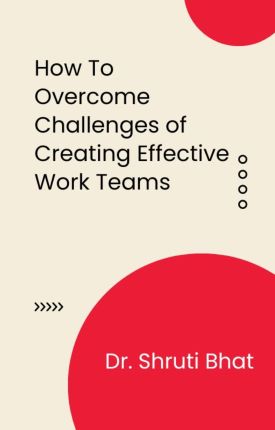
How to Overcome Challenges of Creating Effective Work Teams

10/19/2022

0 Comments

 
How to Overcome Challenges of Creating Effective Work Teams
Creating effective work teams isn't easy, and the challenges are as diverse as the people on the team. Fortunately, organizations can learn how to create a collaborative environment and develop team-building skills. After all, having a poor work environment can negatively impact employee satisfaction and productivity.
 
When forming a work team, it is important to clearly define roles and responsibilities. This helps avoid conflict and ensures that each member understands what their role is. When team members feel like they are part of the same team, they are more likely to work together and trust each other. In addition, a strong working relationship encourages risk-taking and sharing ideas. Developing a code of conduct can also help ensure that employees follow the rules.
 
Another major challenge in creating a work team is conflict. Conflicts often occur because team members have different ideas and opinions. These conflicts create tension between team members and make it difficult to collaborate, expand knowledge, and innovate. It is important to address these conflicts in a positive manner and to respect each team member's opinion.
 
A team can also share files by compressing them into zip files. These zip files can be encrypted and shared faster than other files. Encourage team members to share information among themselves and they will be more willing to share it.
 
Learn more about How to Overcome Challenges of Creating Effective Work Teams in my latest book.
 
Available in electronic format in all popular stores and libraries worldwide.

​
​Follow Shruti on Twitter, Facebook, YouTube, LinkedIn

Categories: HR Development | Leadership 

Keywords and Tags:
#operationalexcellence  #leadership  #teambuilding #teamperformace #effectiveteams #managingconflicts
Get In Touch
0 Comments

How to lead a successful organizational transformation

10/18/2022

0 Comments

 
how to lead a successful organizational transformation by Dr Shruti Bhat
Grab your copy of this book Now! Available as Electronic format in all popular book stores worldwide!

About the book-

There are several basic building blocks for successful organizational transformations. They are not specific steps or stages, nor are they specific organizational designs. Rather, they are perspectives and ways of thinking about shifting behavior and influence.

One key to a successful transformation is to clearly define the end goal. When creating a transformation plan, start with the end result in mind and work backwards from there. Setting timelines for each stage of the transformation project can help you stay focused and make the process more manageable.

For example, if you're switching to a new technology platform, you might want to define the timeline for conducting preliminary research on available tools, submitting RFPs (Request for Proposal), and scheduling demos with vendors. Then, after selecting the best tool, implement it and train employees on using it. But this is easier said than done. Hence, leadership self-development is a constant To-Do on a leader’s list.

If you are a leader or an aspiring leader and want to bring-on organizational transformation or to enhance your leadership skills to elevate along the career ladder, then this book is for you!

With ‘so much’ leaders like us must read daily, I always look for bite-size information that is compact, complete, relevant and useful. This eBook- How to lead a successful organizational transformation, is designed to bring you vital information in an easy, useful and microlearning format.

Available as Electronic format in all popular book stores worldwide!

Checkout the preview here-


​Follow Shruti
 on 
Twitter, Facebook, YouTube, LinkedIn

Categories: Books | Leadership

Keywords and Tags:
#operationalexcellence  #leadership  #businessturnaround #businesstransformation #managingchange
0 Comments

Best Practices of Giving Feedback to Your Seniors and Top Management

10/17/2022

0 Comments

 
Best Practices of Giving Feedback to Your Seniors and Top Management
Giving and receiving feedback is an essential quality for not only leadership development but also for operational excellence. A diligent leader will surely steer his team to meet work goals, thus improving operational excellence and bring-in overall organizational development.
 
In this post, I shall touch upon Best Practices of Giving Feedback to Your Seniors and Top Management. I’ve a separate post on Best Practices of Giving Feedback to Your Subordinates and Peers.
 
So, let’s get started…
 
When giving feedback, you should always remember your goal - to make your boss better. You can do this by asking your supervisor for suggestions or by looking for opportunities to bring up your concerns. These opportunities can arise when you're starting a new project or working with a new client.
 
Positive effects
 
When you're giving feedback to a manager or senior, there are a few best practices that can help you make the most of your time. First, make sure your feedback is actionable. It should be followed up with action and change. Then, make sure your feedback is inclusive of the needs of other team members.
 
Providing positive feedback to your manager can increase his morale and empower his team to keep doing great work. However, all of the feedback that you give must be constructive. If you don't think that the feedback will make a difference in team dynamics, don't give it.
 
Impersonal ways of giving feedback
 
Providing feedback to top management and senior employees can be tricky. Many people are stuck in their ways of thinking, and it can be hard to break through those barriers. But there are some techniques you can use to give good feedback. First, be aware of your audience. Try to give feedback in a neutral manner. Avoid labeling people and referring to them by name. And make sure that your feedback is focused on specific actions and not on their personalities.
 
If you want to provide feedback to top management and seniors, don't be afraid to speak up. While this may seem obvious, it can be tricky in practice. If you wait too long to give feedback, the issue will continue to fester. Furthermore, if your feedback is delayed, the message will be less meaningful to your boss. That may result in a negative reaction from your superiors.
 
Solutions-oriented
 
Giving solutions-oriented feedback to your boss requires that you approach it with the right intentions. Your feedback should be meant to help your boss, not to hurt him or her. It should also be respectful and professional. Your feedback should address specific actions and not your personality. In addition, you should always follow-up to ensure that the suggestions have been implemented.
 
First, give your feedback in person. The best way to do this is to talk to your manager face-to-face, because this will help you avoid miscommunications. Secondly, make sure you are able to give solutions-oriented feedback without overloading your manager.
 
Crystal clear
 
Crystal Clear has a number of advantages over other types of feedback methods. The process allows for small iterations while tracking the progress of projects in real time. However, there are some limitations with the method. Many of the features are left up to the team's creativity, so a lack of standardization can lead to bad results.
 
Crystal method (is an Agile methodology) is flexible, meaning that they can be adjusted to the circumstances and people involved in a project. Unlike other feedback methods, they do not limit the scope of the project; they can adapt to people and budget requirements. In addition to being flexible, they prioritize the key components and can be adapted to meet various business needs.


Follow Shruti on Twitter, Facebook, YouTube, LinkedIn

Categories:  HR Development |Leadership

Keywords and Tags:
#operationalexcellence #givingfeedback #feedbacktoseniors #leadershipskill #leadershipdevelopment  #crytalmethods

Get In Touch
0 Comments

Best Practices of Giving Feedback to Your Subordinates and Peers

10/17/2022

0 Comments

 
Best Practices of Giving Feedback to Your Subordinates and Peers
Giving and receiving feedback is an essential quality for not only leadership development but also for operational excellence. A diligent leader will surely steer his team to meet work goals, thus improving operational excellence and bring-in overall organizational development.
 
In this post, I shall touch upon Best Practices of Giving Feedback to Your Subordinates and Peers. I’ve a separate post on Best Practices of Giving Feedback to Your Seniors and Top Management.
 
There are certain best practices when giving feedback to your subordinates and peers. These include being constructive and encouraging, explaining the impact of your feedback, and personalizing the feedback. In addition, you should also be sure not to bring up a sensitive subject. Rather, you should be respectful and courteous.
 
Positive feedback
 
Providing positive feedback to your employees is important for their development. This feedback should be specific to the employee's effort, not general. It should also be delivered in a way that does not create confusion or lose meaning. Positive feedback is a powerful tool for motivating employees and fostering a growth mindset.
 
Giving positive feedback is easy, but it should be sincere and meaningful. It should reinforce positive behaviors and should be given in the moment. Giving praise too late can leave employees feeling unappreciated.
 
Constructive criticism
 
Giving constructive criticism can be difficult. It engages the fight-or-flight response in a person. However, this type of feedback can also help improve performance. The key is to listen to the other person without responding and to keep an open mind when giving feedback.
 
When giving feedback, make sure to keep the tone positive and respectful. Peers are more receptive to feedback that is given in a constructive manner. Keep in mind that the purpose of providing feedback is to help solve a problem, not to offend someone. It's also important to be specific, instead of skirting the issue or trying to explain why something is a problem. Give examples of what you think needs to change and provide solutions if possible.
 
Explaining impact of behavior
 
Giving feedback to subordinates and peers can have significant benefits for the person receiving it. It can help improve the quality of the work, influence the trajectory of a person's career, and even increase job satisfaction. Conversely, withholding feedback can make people resentful or frustrated.
 
Giving timely and meaningful feedback is critical to the employee experience. It builds trusting relationships, fosters a better team, and creates a more humane company culture. Giving feedback takes time and energy, but it can be incredibly valuable. It also shows that you are invested in the person's progress.
 
Personalizing feedback
 
While giving feedback to subordinates and peers, it is important not to personalize it. Giving feedback that is too personal will lead to clouded thinking and will encourage the receiver to blame themselves instead of the situation. This can lead to the fundamental attribution error, wherein we incorrectly blame ourselves for the behavior of others.
 
The best way to personalize feedback is to put it in context. It can be as simple as introducing negative feedback before a positive one. It also eliminates any potential for embarrassment.
 

Follow Shruti on Twitter, Facebook, YouTube, LinkedIn


Categories:  HR Development | Leadership

Keywords and Tags:
#givingfeedback #feedbacktopeers  #feedbacktosubordinates  #personalizefeedback  #constructivefeedback
Get In Touch
0 Comments

How To Overcome Challenges of Creating Effective Work Teams

10/15/2022

0 Comments

 
how to overcome challenges of creating effective work teams
​Grab your copy of this book Now! Available as Electronic format in all popular book stores worldwide!

About the book-

Building effective work teams is not always easy, and there are as many ways to go wrong as there are people on a team. But as long as a team is focused on the task at hand, it is possible to overcome many of the common challenges and create an effective working environment.

Building a team and to reach its potential is perhaps the fundamental role of any leader, but it is not an easy job. Hence, self-development as a leader is a constant to-do on a leader’s list.

With ‘so much’ leaders like us must read daily, I always look for bite-size information that is compact, complete, relevant and useful. Hence, I thought of creating this sub-series, The Leader’s Ladder. The eBooks in this series are designed to bring you vital information in an easy to learn and use format.

If you are a leader or an aspiring leader and want to enhance your leadership skills to elevate along the career ladder, then this book is for you!

Available as Electronic format in all popular book stores worldwide!
​

Follow Shruti on 
Twitter, Facebook, YouTube, LinkedIn

Categories: Books | Leadership

Keywords and Tags:
#operationalexcellence  #leadership  #teambuilding #teamperformace #effectiveteams #managingconflicts
0 Comments

What Are the Tools for Decision-Making?

10/13/2022

0 Comments

 
what are the tools for decision making
​​Flowcharts, Pareto analysis, and Stability analysis are some tools used to help you make a decision. Each of these tools can help you generate alternatives to your problem.

​
The first step in using these tools is to formulate an idea of the problem. Once you have a general idea of the problem, use the tools to brainstorm solutions. Using these tools will also help you identify the factors that might have an impact on the problem.

Cost-benefit analysis
The cost-benefit analysis process starts with a comprehensive list of costs. These costs include direct labor in manufacturing and indirect costs like management overhead and rent or utilities. There are also intangible costs, such as impact on customers, employees, or delivery times. Other considerations include opportunity costs, regulatory risks, and environmental effects. For example, the new product might increase revenue, but the benefits may be in improved employee safety and product offerings or faster delivery.

Cost-benefit analysis is a simple tool that evaluates various options by comparing their costs to their benefits. By weighing the costs and benefits of a project, businesses can decide which option will be best for them. The process helps businesses identify which investments will be beneficial and which ones will have negative consequences. In addition, the process also includes forecasts. The benefits of a project must outweigh the costs in order to be considered a good decision.

Flowcharts
Flowcharts can be used to explain complicated processes. They can be used to explain multiple routes to a decision or completion. Using flowcharts as decision-making tools can improve your business. Here are some tips to help you use flowcharts as decision-making tools. Let's begin. First, understand the concept of a decision flowcharts. They are a visual representation of a process that shows which steps must be taken and why.

Flowcharts are typically a series of steps in a process. Using a flowchart template, you can easily represent the various steps of the process and determine where responsibility lies. A flowchart can help you identify where the problem lies and whether there are any opportunities to improve your process. There are many flowchart templates and resources available online that can help you make the most of these charts.

Pareto analysis
The process of identifying factors that have the most influence on a business's success is known as a Pareto analysis. It consists of separating input factors into their most important impacts and determining which ones have the biggest influence. This analysis can be used to frame relevant strategies and implement effective changes. The steps of the process are listed below. Using a Pareto chart, identify factors and order them in the most important order.

Using the Pareto Analysis as a tool for decision-making is particularly useful in scenarios where resources are limited. The 80/20 rule helps you identify the 20 percent of actions that will generate 80 percent of the outcome. This method is also useful in business because it works well with factors such as factor sparsity, which refers to a shortage of resources. For example, many business opportunities have more potential than resources to implement them.

Stability analysis
Decision-making is often influenced by uncertainty and sensitivity, and stability analysis can provide critical inputs to decision-making models. Stability analysis compares alternative scenarios to the actual probability of the events. Various computer packages exist for decision-making stability and sensitivity analysis. Here are some examples:

One of the most important aspects of stability analysis is the appropriate time interval. The longer the time interval, the more likely the measurement system will be unstable. In addition, knowledge of the environment in which the equipment is used can help identify special causes. Once these special causes are identified, steps must be taken to make the measurement system more reliable.

Decision trees
When more than one person is involved in a decision-making process, decision trees as tools can help you narrow the list of options. Decision trees are graphs where a decision is contemplated. The decisions in the decision tree are subjected to statistical analysis. Decision trees can also help you narrow your list of options down to a small group. Pareto analysis can help you prioritize decisions. Pareto analysis measures which decisions will have the greatest impact on the group. While Cost-benefit analysis weighs the financial and economic ramifications of a decision.

​How fast a decision is made and how good is that decision determines how far the business will thrive.

​
Checkout- Top Ten Strategic Decision-Making Tools for Operational Excellence

Related Reading:
  1. Top Ten Strategic Decision-Making Tools for Operational Excellence
  2. ​How to cut costs strategically using Kaizen
  3. Top 30 Continuous Improvement Tools
  4. Top 10 Change Management models

Follow Shruti on Twitter, Facebook, YouTube, LinkedIn

Categories:  Strategy | Leadership

Keywords and Tags:
#strategicdecisionmaking #strategy  #strategymanagement #decisiontools #decisionmaking #strategicplanning  #challengesofdecisionmaking  #operationalexcellence
Get In Touch
0 Comments
<<Previous
Forward>>

    New Book Released!

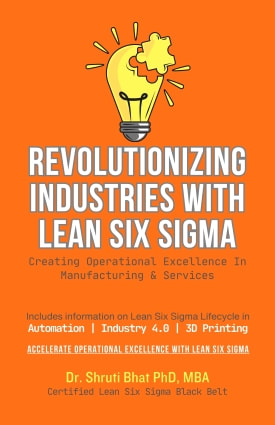
    Revolutionizing Industries with Lean Six Sigma

    Shruti's YouTube Channel ...

    Picture

    Blog Categories

    All
    3D Printing
    Agile
    Artificial Intelligence
    Automation
    Biotechnology
    Books
    Business Continuity
    Business Turnaround
    Case Studies
    Change Management
    Checklists
    Chemical Industry
    Continuous Improvement
    Design Thinking
    Digitalization
    Drug Delivery
    External News Links
    Hall Of Fame
    Healthcare
    Hoshin Kanri
    HR Development
    Innovation
    Insights
    ISO
    Just In Time
    Kaizen
    Leadership
    LEAN
    Lean Six Sigma
    Life Sciences
    Machine Learning
    Manufacturing
    Medical Devices & Prosthetics
    Mistake Proofing
    Motivational Cards
    MSMEs
    Nanotechnology
    Operational Excellence
    OpEx Models
    Packaging
    Patents
    Personal Products
    Process Improvement
    Product Development
    Productivity Increase
    QbD
    Quality Management
    R&D Leadership
    Robotics
    Service Industry
    Six Sigma
    Strategy
    Supply Chain Logistics
    Telecom Industry
    Templates
    TQM
    Videos
    Voice Of Customer
    Whitepaper
    Workshops

    Shruti's books...

    Picture
    top ten strategic decision-making tools for operational excellence
    shruti bhat, business process management, continuous improvement
    kaizen for pharmaceutcials, medical devices and biotech industry book by Dr Shruti Bhat
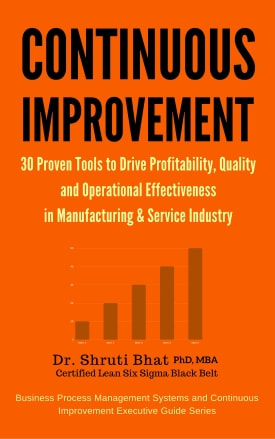
    Book on Continuous improvement tools by Dr Shruti Bhat
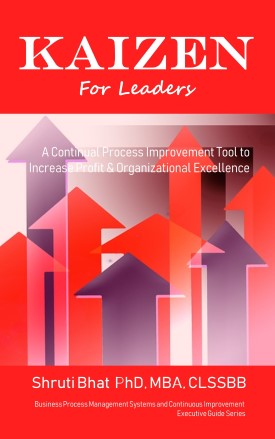
    kaizen for leaders, continuous process improvement tool to increase profit and organizational excellence by shruti bhat
    kaizen, shruti bhat, continuous improvement, quality, operations management
    how to lead a successful business transformation
    leading organizations through crisis
    emotional intelligence
    how to overcome challenges of creating effective teams
    modular kaizen Vs Blitz kaizen
    How to increase employee engagement as a new boss

Connect with Dr. Shruti Bhat at- ​YouTube, LinkedIn​ and X

© Copyright 1992- 2026 Dr. Shruti Bhat ALL RIGHTS RESERVED.
See Terms and Conditions details for this site usage.
Picture
Subscribe to PharmaOps Consulting YouTube Channel
Subscribe to Operational Excellence Academy YouTube Channel
​Subscribe to Operational Excellence Academy YouTube Channel
SHRUTI BHAT, CONTACT
Click to connect.
Disclaimer:
  • All content (and in all formats) provided on this site is for educational purposes only. It does not constitute legal, regulatory, quality, financial, medical or professional advice. If you wish to apply ideas contained on this site, web pages, resources bank, tools and/or blog; collectively referred to as website, you are taking full responsibility for your actions. 
  • No professional-client relationship is created by reading or using this content. 
  • ​To the fullest extent permitted by law, the author(s), Dr. Shruti Bhat and website owner disclaim liability for any loss or damage arising from reliance on the information contained herein. Read full disclaimer here before reviewing the site.
Created by Macro2Micro Media