Shruti Bhat PhD, MBA, Operations Excellence Expert
  • Home
  • Operational Excellence Hub
  • About Shruti
  • Insights
  • Writings
    • Process Improvement
    • Business Transformation
    • Innovation Management
    • Leading Research and Development
    • Developer's Diary
    • Business Continuity
    • Change Management
    • Digital Transformation
    • Quality Improvement and Compliance
    • Free eBooks and Whitepapers
    • Checklists and Templates
  • Books
  • Blog
  • Services
    • PharmaOps Consulting
    • Tara LeanWorks
    • Training Services
  • Case Studies
  • Patents
  • Print Publications
  • Videos
  • Contact

The Role of Kaizen and Lean in Building Sustainable Canadian Pharma and Allied Businesses

5/15/2025

0 Comments

 
Spotlight:
New data released (May 2025) by Statistics Canada confirms that Canada’s innovative pharmaceutical industry is more than a contributor to health, it is a driver of national economic growth and resilience. 

Growing a strong, competitive domestic life sciences sector with cutting edge biomanufacturing capabilities and ensuring preparedness for pandemics or other health emergencies is a strategic need.

Building Canada's domestic capabilities in biomanufacturing and life sciences will help not only improve readiness and self-reliance in responding to future health or geopolitical emergencies but also contribute to Canada's economic growth, create good jobs, and increase Canada's contributions to the development of the next generation of medicines.

It is heartening to see that Canadian pharma companies and life sciences sector in general, are ready to take on the challenge. However, it is equally true that increasing regulatory pressure, rising operational costs, and mounting environmental expectations are reshaping the industry.

To remain competitive and sustainable, organizations must move beyond compliance and efficiency metrics—they must rethink how work is done, at every level.

This is where Kaizen and Lean offer more than mere process improvement: they provide a philosophy for long-term resilience.
​
Read the full post below…
the role of kaizen and lean in building sustainable Canadian pharma and allied businesses
Canada’s pharma and other life sciences industries are under pressure to cut waste, meet sustainability targets, and remain globally competitive. The answer lies not in one-time fixes but in adopting Kaizen and Lean as core philosophies. Here’s why they matter more than ever…
 
Why Sustainability in Pharma is Not Optional

Canada’s pharma and allied sectors—spanning medical devices, biotech, and healthcare supply chains—operate in highly resource-intensive environments. Regulatory standards, patient safety, and product integrity demand flawless operations, yet these same industries face increasing scrutiny over waste, carbon emissions, and supply inefficiencies.

Sustainability, therefore, is not a “green add-on.” It is becoming central to risk management, competitiveness, and reputation. The question is: how do organizations embed sustainability in a way that enhances rather than constrains performance?

Kaizen: Continual Improvement with Lasting Impact

Kaizen is more than small fixes—it is a cultural mindset where every employee, from lab technicians to supply chain managers, is empowered to identify and act on opportunities for improvement.

In pharma, this could mean for example-
  • Reducing energy consumption in cleanrooms through smarter scheduling.
  • Simplifying documentation processes to cut redundant paperwork.
  • Engaging cross-functional teams to minimize rework in quality control.

Each improvement may seem incremental, but collectively, they transform how an organization operates—aligning cost-savings with sustainability goals.
 
ALSO READ: Implementing Kaizen principles for process optimization- Whitepaper
 
Lean: Precision and Waste Elimination in Complex Systems

Lean’s focus on eliminating waste (muda in Japanese) resonates strongly in pharma, where both compliance and speed-to-market are non-negotiable.

Waste here is not just physical—it is idle time in R&D pipelines, excess inventory in warehouses, or overproduction of trial materials.

For Canadian pharma, Lean enables:
  • Streamlined drug development cycles without compromising regulatory rigor.
  • More agile supply chains, resilient against disruptions like pandemics.
  • Reduced carbon footprint by aligning production more closely with demand.

The Intersection: Sustainability Through Operational Excellence

When Kaizen and Lean converge, sustainability is no longer a siloed initiative—it becomes embedded in daily operations. Crucially, this integration addresses three pressing needs in Canadian pharma:
  1. Regulatory Alignment – Lean reduces errors, while Kaizen drives consistency. Together, they build compliance into the process itself.
  2. Environmental Responsibility – Waste reduction directly lowers environmental impact, from packaging to energy consumption.
  3. Organizational Resilience – Continuous improvement equips teams to adapt quickly to changing regulations, market dynamics, customer demands (for example singly packed dosage forms Vs kit products) manufacturing and supply challenges.

Lessons From the Field (Global Pharma Sector)
  • A medical device manufacturer used Kaizen workshops to uncover hidden inefficiencies in sterilization processes, reducing energy use by 15%.
  • A pharma distribution firm adopted Lean inventory practices, cutting both warehouse costs and product spoilage, while enhancing service reliability.
  • A biotech research lab applied Kaizen principles to its documentation systems, reducing regulatory submission errors and accelerating approval timelines.

These examples underscore a truth: sustainability and competitiveness are not opposing forces. With Kaizen and Lean, they reinforce each other.

Although these success stories may not be from Canadian companies, the learnings can be easily extended and successfully implemented by life sciences companies in Canada and also globally.
 
ALSO READ:  Operational excellence case studies from Pharma Manufacturing
 
Moving Forward: A Leadership Imperative

The conversation around sustainability in Canadian pharma must mature. Too often, “sustainable practices” are limited to recycling bins in offices or CSR reports. True sustainability is operational—it is how a lab minimizes rework, how a distribution center eliminates redundant transport, how a manufacturer integrates eco-conscious design.
 
ALSO READ:  Operational excellence case studies on Improving R&D Productivity
 
Leaders who embrace Kaizen and Lean in their organizations are not only improving efficiency—they are setting the foundations for an industry that can withstand economic, regulatory, and environmental shocks.

The Canadian pharma and allied sectors are uniquely positioned to lead the sustainability agenda—through disciplined and proven process optimization practices. Kaizen and Lean are not quick fixes; they are strategic enablers of quick, yet long-term resilience.

For organizations ready to go beyond compliance and efficiency, the journey begins with rethinking operations at every level.
 
Conclusion

Sustainability is not an isolated initiative for Canadian pharma and allied businesses—it is the cornerstone of future competitiveness and resilience. By embracing Kaizen and Lean, leaders can transform sustainability from a compliance checkbox into a driver of operational excellence. These principles enable companies to cut costs, minimize waste, adapt quickly to disruption, and meet environmental targets without compromising innovation or patient safety. The organizations that adopt Kaizen and Lean today will be the ones shaping a stronger, greener, and more competitive Canadian life sciences sector tomorrow.
​
📌 The future of Canadian pharma will belong to organizations that embed sustainability into their DNA. If you’re serious about leading this shift, Partner with Us for Consulting & Training – let’s build your roadmap to sustainable excellence.
Get in Touch
Operational Excellence Case Studies at: https://www.drshrutibhat.com/operational-excellence-case-studies-manufacturing-and-services.html 

Keywords and Tags:
#PharmaSustainability #Kaizen #Lean #CanadianPharma #LifeSciences #OperationalExcellence #ContinuousImprovement

​​Categories:  Operational Excellence | Life Science Industry | Lean | Kaizen

​Follow Shruti on YouTube, LinkedIn, X

​Subscribe to Operational Excellence Academy YouTube channel:

Picture
0 Comments

Kaizen for CDMOs & CROs: How Continuous Improvement Drives Operational Excellence in Pharma and Biotech

5/10/2025

0 Comments

 
Is your CDMO or CRO stuck in a cycle of inefficiency, delays, and rising costs? Here's how Kaizen can help you break through.

Contract development and manufacturing organizations (CDMOs) and contract research organizations (CROs) operate under intense pressure—tight timelines, strict regulations and constant innovation. Also, the CDMO, CRO operational processes are more complex than a regular R&D department within an organization. Therefore, Kaizen implementation in a CDMO set up is a bit tougher than implementing it in a R&D division. In addition to operational issues, the CDMO’s, CRO’s organizational culture, size, product mix, geographies of business play key roles in its working.

Kaizen, a continuous improvement framework, offers a structured approach to tackle bottlenecks, streamline processes and empower teams from the lab bench to the boardroom. In this post, I will discuss practical steps to enhance operational excellence (without massive overhauls) in CDMO, CRO facilities.

Note that, Kaizen isn’t just for the auto sector. It’s a proven way for CDMOs and CROs to cut waste, boost quality and engage staff in meaningful improvements. When every small change compounds operational excellence, it becomes a habit—not a hope.

Ready to take small steps toward big gains? Dive into my post below on how Kaizen can transform your CDMO or CRO operations…
Kaizen for CDMOs & CROs_ How Continuous Improvement Drives Operational Excellence in Pharma and Biotech
​Why Operational Excellence Matters for CDMOs and CROs?
CDMOs and CROs are vital to pharmaceutical and biotech pipelines. But these organizations face a common set of operational challenges:
  • Bottlenecks in clinical trial and production workflows.
  • Waste from overprocessing or waiting.
  • Quality deviations under regulatory scrutiny.
  • Underutilized talent on the shop floor and in labs.

In such environments, Kaizen—the Japanese approach to continual improvement—offers a structured yet flexible methodology to identify inefficiencies, engage staff and deliver consistent operational gains.

What is Kaizen?
At its core, Kaizen means "make better." It emphasizes:
  • Small, incremental improvements.
  • Empowering employees at all levels.
  • Standardized work.
  • Problem-solving via root cause analysis.
For CDMOs and CROs, it helps bridge gaps between R&D, quality and manufacturing by creating a culture where improvement is everyone's job.

Where Kaizen Can Be Applied in CDMO/CRO Settings:
Kaizen can be applied to several functional areas of the CDMO, CRO such as clinical study, quality assurance, production, project management, regulatory filings etc. The below table gives an example of where Kaizen can be applied in CDMO/ CRO set ups.
kaizen application
An obvious question is- How to begin Kaizen initiative in the CDMO, CRO facility?

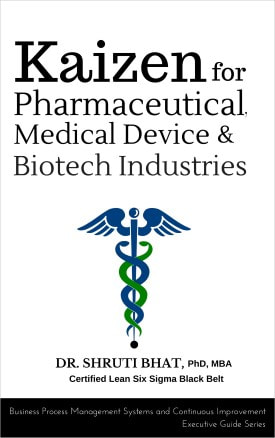
I have covered this in-depth in my book- Kaizen for Pharmaceutical, Medical Device and Biotech Industries. You may want to check it out ​here. Having said that, I shall now briefly discuss how to begin with Kaizen…
​
How to Get Started with Kaizen
1. Start Small: Choose a single bottleneck area (e.g., deviations, turnaround time). This in Kaizen parlance is called ‘muda’ or waste. The picture below gives common types of waste prevalent in CDMO, CRO set ups.
types of waste in CDMO, CRO labs
​2. Form a Kaizen Team: Cross-functional, with floor-level operators included.
3. Use Visual Tools:
Process mapping, fishbone diagrams, daily huddle boards.
4. Empower and Train: Teach staff the basics of root cause analysis and standard work.
5. Track, Reflect, Repeat: Use metrics and reflection cycles (such as PDCA) to scale wins.

Though Kaizen implementation usually follows PDCA cycle (plan-do-check-act cycle), I have used other frameworks too which augment the benefits of Kaizen while facilitating Kaizen implementation within the approved time- scope-budget. Let me share a Kaizen in Pharma CDMO success story…
​
We implemented Kaizen in a SE Asian mid-size CDMO company. And, the benefits of Kaizen were visible in mere six months!
operational metrics before and after kaizen
​Therefore, I always say that- Operational excellence is not just a competitive advantage—it's a necessity for CDMOs and CROs navigating complex regulatory landscapes, tight timelines, and high client expectations. Kaizen offers a practical, people-centric approach to identifying inefficiencies, reducing waste, and fostering a culture of continuous improvement.

By starting small and building momentum through measurable wins, organizations can create lasting change that boosts quality, productivity, and team engagement.
​
Ready to bring Kaizen into your CDMO or CRO operations? Begin with a small step—identify one bottleneck, form a team, and commit to improving it. For a detailed roadmap, real-world examples, and implementation tools, explore my book Kaizen for Pharmaceutical, Medical Device and Biotech Industries. Let’s build a culture where every team member contributes to excellence—one improvement at a time.
Get in Touch
More Operational Excellence Case Studies at: https://www.drshrutibhat.com/blog/category/case-studies

Keywords and Tags:
#CDMO #CRO #OperationalExcellence #Kaizen #ContinuousImprovement #LeanManufacturing #BiotechOps #PharmaInnovation #GMP #SixSigma
​​
Categories:  Operational Excellence | Life Science Industry | Kaizen 

​Follow Shruti on Twitter, YouTube, LinkedIn

​​Subscribe to Operational Excellence Academy YouTube channel:

Picture
0 Comments

How Kaizen Boosted Stability, Compliance and Reduced Batch Deviations in Pharma Manufacturing

5/10/2025

0 Comments

 
Spotlight: Is batch variability affecting your pharma compliance? Checkout how Kaizen transformed chaos into compliance and consistency, driving down batch deviations by 40% in pharma manufacturing.

This post details how targeted Kaizen initiatives significantly reduced deviations, boosted regulatory compliance, improved SOP adherence, and built stronger collaboration between production and QA teams in a mid-sized SE Asian pharma company.

Consistency and compliance aren’t automatic—but Kaizen makes them achievable!

Ready to enhance your compliance and operational consistency? Start your Kaizen journey today— read full case study below...
how kaizen boosted stability, compiance and reduced batch deviations in pharma manufacturing
How Kaizen Boosted Stability, Compliance and Reduced Batch Deviations in Pharma Manufacturing: Case Study

The Challenge: Tackling Variability and Compliance Risks
In pharmaceutical manufacturing, variability and compliance risks can be devastating. This case study is about how a mid-sized SE Asian pharma company successfully implemented Kaizen to sort out its compliance issues and audit vulnerability which adversely impacted its productivity, operational cost and customer trust.

Root cause analysis showed that each shift performed procedures slightly differently, multiplying errors and inefficiencies. Batch variability, deviation spikes, and operator-driven inconsistencies were creating compliance risks and eroding customer confidence. Quality events, rework, batch delays and rejects were adding cost and risk. Process variation was showing up in the metrics—and the market.

The Kaizen Solution: Cultivating Stability and Compliance through Continual Improvement
Kaizen’s power lies in its emphasis on continual, incremental improvements that build sustainable compliance and operational stability. Our initiatives focused squarely on:
  • Reducing Human Error: Specialized teams tackled variability by standardizing critical procedures, enhancing compliance.
  • Gemba Walks, Layered Audits & Coaching: Regular gemba walks and audits reinforced adherence to Standard Operating Procedures (SOPs), boosting compliance across operations.
  • Quick Wins: Short-term successes were leveraged to drive long-term cultural adoption of continuous compliance improvement.

Implementing the Fix:
  • Cross-Shift Alignment: Kaizen events aligned shifts on compliance-driven best practices.
  • Visual SOPs & Mistake-Proofing: Clear visual instructions and error-proofing at critical points significantly reduced operator errors, improving compliance.
  • Proactive Daily Huddles: Daily team discussions emphasized deviation prevention, embedding proactive compliance into daily operations.

The Results: Transformative Stability and Compliance
  • 40% drop in batch deviations, enhanced operational reliability and regulatory compliance. Faster batch release.
  • SOP adherence up across all shifts.
  • Improved audit readiness and regulatory confidence.
  • Stronger collaboration between production and QA. Predictable performance across lines and shifts. Operators owning quality; fostering a culture of continuous regulatory excellence.
impact of kaizen initiatives on pharma manufacturing metrics
​Key Takeaway: Compliance Equals Trust
In pharma manufacturing, consistency and compliance aren’t just operational metrics—they're the foundation of regulatory success and customer trust. Kaizen brings teams together to fine-tune the details that matter most.

Kaizen doesn’t just address immediate problems—it transforms the operational culture, embedding sustainable, repeatable compliance excellence into daily practices. And, process consistency isn’t automatic—but Kaizen makes it achievable, repeatable, and scalable.
​
Kaizen isn’t just about fixing problems—it’s about embedding consistency and capability into your operations.
Ready to enhance your compliance and operational consistency? Start your Kaizen journey today…
Get in Touch
More Operational Excellence Case Studies at: https://www.drshrutibhat.com/blog/category/case-studies

Keywords and Tags:
#Kaizen #PharmaManufacturing #OperationalExcellence #QualityCulture #ContinuousImprovement #ProcessStability #LeanPharma #PharmaLeadership #SitePerformance #LeanStrategy #ProcessReliability #QualityExcellence #LeanInPharma #GMPCulture #KaizenOnTheFloor #BatchReliability #OpsExcellence #ComplianceExcellence
​​
Categories:  Operational Excellence Case Studies | Life Science Industry | Kaizen 

​Follow Shruti on Twitter, YouTube, LinkedIn

​Subscribe to Operational Excellence Academy YouTube channel:

Picture
0 Comments

How a Pharma Plant Cut Analysis Costs by 35% in 5 Days Using Blitz Kaizen

5/8/2025

0 Comments

 
Spotlight: 💥 Slashed Analysis Costs in Pharma Manufacturing by 35%—in Just 5 Days!

Discover how a focused Blitz Kaizen sprint delivered rapid, measurable cost savings without disrupting operations. In a high-pressure manufacturing environment, speed and precision are everything. We worked with a pharmaceutical plant where the cost of product quality analysis was spiraling. The solution? A Blitz Kaizen approach—focused, fast, and deeply effective.

We facilitated a 5-day Kaizen sprint that brought together stakeholders from QC, production, QA, regulatory and IT. The goal was to streamline the analysis process, identify quick wins, and reduce waste across the system.

Result highlights:
  • 35% reduction in analysis cost.
  • 40% improvement in lab turnaround time.
  • 28% reduction in sample backlog.
  • $180K annualized savings achieved within 2 months (savings sustained YoY).
  • No capital investment required.
Imagine achieving these gains in your own facility in less than a week!

📌 Want results like these for your facility?  Checkout the full case study below...
How a Pharma Plant Cut Analysis Costs by 35% in 5 Days Using Blitz Kaizen
Case study: How a Pharma Plant Cut Analysis Costs by 35% in 5 Days Using Blitz Kaizen!

A global pharmaceutical manufacturer was grappling with rising analysis costs, delayed lab results, and inefficient resource utilization—factors that directly impacted batch release timelines and operational agility.

Executive Summary
In today’s pharmaceutical manufacturing landscape, cost pressures, compliance demands, and time-to-market imperatives are more intense than ever. One often-overlooked area that contributes significantly to operational cost is quality control and analytical testing. In this case study, I discuss how a 5-day Blitz Kaizen helped a pharma company achieve a 35% reduction in analysis cost, 40% improvement in lab turnaround time and $180K in annualized savings—without any capital expenditure.

The Challenge: Hidden Costs in the Lab
A mid-sized pharma manufacturing site was experiencing recurring challenges in its quality control laboratory:
  • Rising costs per analysis due to inefficient workflows and resource duplication.
  • Delays in analytical results, creating bottlenecks in batch release.
  • Growing backlog of samples and limited visibility on performance metrics.
  • Analysts spending excessive time on manual paperwork and administrative steps.

Despite investments in equipment and trained personnel, lab performance was lagging—and executive leadership needed a fast, effective, and sustainable solution.

The Solution: A 5-Day Blitz Kaizen
Rather than opt for a long-term transformation initiative, the leadership team piloted a Blitz Kaizen: a focused, high-intensity lean event aimed at delivering rapid results.

Our consulting expert team facilitated a 5-day Kaizen sprint that brought together stakeholders from QC, production, QA, regulatory and IT. The goal was to streamline the analysis process, identify quick wins and reduce waste across the system.

Key Kaizen interventions were:
  1. Value Stream Mapping (VSM) of sample-to-report process.
  2. Identifying and eliminating non-value-added activities.
  3. Reorganizing lab layout to improve flow and reduce motion waste.
  4. Implementing a skill-based scheduling matrix to optimize human resources.
  5. Digitizing the test request form and simplifying data entry.
  6. Establishing daily lab performance huddles with metrics visibility.
 
The Outcomes: Tangible, Measurable Gains
Within just 5 days, the lab team achieved results that exceeded expectations. The improvements were tracked using pre-and post-Kaizen metrics across key performance indicators (KPIs).

Key Results:
  • 35% reduction in analysis cost.
  • 40% improvement in turnaround time (TAT) for high-priority samples.
  • 28% reduction in sample backlog within 2 weeks post-event.
  • $180,000 in annualized cost savings.
  • Zero additional capex—all gains from process optimization.
  • High team morale and renewed sense of ownership in lab performance.
How a Pharma Plant Cut Analysis Costs by 35% in 5 Days Using Blitz Kaizen
​“This is the first time we’ve seen such fast results with no budget increase. The team feels empowered, and leadership finally has visibility into lab performance.”
— QC Head, Pharma Plant

​Why Blitz Kaizen Works: Strategy Meets Speed
Traditional process improvement approaches often fail because they are slow, over-engineered or disconnected from day-to-day operations.

​Blitz Kaizen flips that model by emphasizing:
  • Speed over perfection: Rapid implementation and iteration.
  • On-the-floor engagement: Real-time problem solving with actual users.
  • Immediate results: Outcomes visible within a working week.
  • Cross-functional alignment: Everyone from operators to executives involved.

The results are not just operational—they’re cultural. Teams shift from passive compliance to proactive problem-solving.

This case study proved that:
  • Lab inefficiencies are silent profit killers—but also untapped gold mines.
  • Quick wins can be strategic wins—you don’t need a 6-month initiative to see ROI.
  • Frontline teams know the answers—they just need the right framework and empowerment.
  • Blitz Kaizen works without disruption—there’s no need to shut down operations.

📌 Ready to replicate these gains in your own facility in less than a week? Let’s discuss how a customized Blitz Kaizen can be tailored to your operational pain points.
Get in Touch
More Operational Excellence Case Studies at: https://www.drshrutibhat.com/blog/category/case-studies

Keywords and Tags:
#PharmaManufacturing #LeanSixSigma #Kaizen #OperationalExcellence #BlitzKaizen #CostReduction #CEOInsights #ManufacturingLeadership #DigitalLean #AgileOps #ConsultingForResults
​​
Categories:  Case Studies | Life Science Industry | Kaizen 

​Follow Shruti on Twitter, YouTube, LinkedIn

​Subscribe to Operational Excellence Academy YouTube channel:

operational excellence academy
0 Comments

5 Operational Bottlenecks That Slow Down SMEs—And How to Fix Them

3/8/2025

0 Comments

 
Hidden bottlenecks are quietly killing your growth! From decision-making delays to outdated systems, SMEs often struggle with invisible roadblocks that slow progress and drain efficiency.
​

The fix? Spot them early & streamline your operations.
5 Operational Bottlenecks That Slow Down SMEs--And How to Fix Them
Over the years, I have seen five common bottlenecks that repeatedly hold SMEs back. Here’s how to fix them before they stunt your growth:

1. Slow Decision-Making
The problem: Critical decisions get delayed due to scattered information and unclear approval processes.
The fix: Establish a clear decision-making framework. Define who has the authority for what, streamline approvals, and centralize business insights on a single platform to ensure quick and informed decision-making.

2️. Constantly in Reactive Mode
The problem: Too much time is spent firefighting—dealing with last-minute issues, missed deadlines, and preventable errors.
The fix: Shift to proactive planning. Standard operating procedures (SOPs), structured workflows, regular planning sessions and huddle events help teams stay ahead of tasks instead of always playing catch-up.

3️. Work Bottlenecked by One Person
The problem: Certain processes depend on a single employee or leader, slowing everything down when they are unavailable.
The fix: Distribute responsibilities and document knowledge. Cross- train team members so expertise is shared and empower employees with clear guidelines to make decisions within their scope.

4️. Inefficient or Outdated Systems
The problem: Manual processes, disconnected platforms, and inefficient workflows create unnecessary delays.
The fix: Assess your operational systems. Look for opportunities to automate repetitive tasks. Also, eliminate outdated processes that no longer serve the business. Kaizen events help the most to address this problem and maximize productivity gains.

5️. Scaling Feels Chaotic
The problem: As the business grows, processes that once worked start breaking down, leading to miscommunication and operational inefficiencies.
The fix: Build scalable systems early. Standardized workflows, clear role definitions, and structured accountability ensure that growth doesn’t lead to chaos.

Bottlenecks don’t just slow a business down—they limit its full potential. The good news? Every challenge is an opportunity for improvement. The key is identifying inefficiencies early and proactively addressing them before they become roadblocks.
​

Which bottleneck do you struggle with the most? Drop a comment below!  
Get in Touch
Checkout Operational Excellence Case Studies at: https://www.drshrutibhat.com/blog/category/case-studies

Keywords and Tags:
#SMEs #Growth #Efficiency #BusinessOperations #Leadership #Scalability #ProcessImprovement #KaizenEvents

Categories:  Continuous Improvement | SMEs | Operational Excellence 

​Follow Shruti on Twitter, YouTube, LinkedIn

​​Subscribe to Operational Excellence Academy YouTube channel:

Picture
0 Comments

Reducing Scrap in Rubber Manufacturing with Kaizen.

1/23/2025

0 Comments

 
Spotlight: A rubber manufacturing company was facing high scrap levels, leading to rising costs and production challenges. The solution? Kaizen, the Japanese methodology of continuous improvement.

By analyzing production processes, identifying waste, and empowering operators through training and collaboration, the company achieved 25% reduction in scrap levels, Lower material costs, Streamlined workflows and enhanced efficiency. This transformation proves that small, incremental changes can drive big results. Kaizen fostered a culture of proactive problem-solving, creating sustainable success in a competitive industry. Read full case study below…
Reducing Scrap in Rubber Manufacturing with Kaizen
Reducing Scrap in Rubber Manufacturing with Kaizen- A Case Study.

A North American rubber manufacturing company was struggling with high scrap levels, resulting in substantial material waste and escalating costs. These inefficiencies not only inflated operational expenses but also hindered the company’s ability to meet production targets consistently. Recognizing the need for a solution to address these costly issues, the company sought an approach that would reduce waste while empowering operators to contribute to more efficient production practices.

The solution came in the form of Kaizen, a Japanese methodology centered around continuous improvement. By implementing a Kaizen approach, they focused on identifying sources of waste within the production process and establishing a culture of ongoing optimization. The team began by analyzing each stage of production, pinpointing areas where material waste was most prominent. Operator training was a key component, as we equipped employees with the tools and knowledge to spot inefficiencies and make incremental improvements in their daily work. Regular Kaizen workshops were also introduced, allowing operators to collaborate on identifying and implementing solutions that minimized waste and streamlined workflow.

The results were transformative. Scrap levels were reduced by 25%, significantly lowering material costs and contributing to more sustainable production. The structured approach to process control improved operator efficiency, as employees became more proactive in maintaining production standards and preventing waste. These improvements translated into considerable savings in material costs, reinforcing the company’s commitment to operational efficiency and cost-effectiveness.

This success story underscores the tangible benefits of Kaizen in manufacturing. By fostering a culture of continuous improvement, the rubber manufacturer was able to reduce waste, enhance process control, and achieve sustainable cost savings. Kaizen proved that even small, incremental changes could lead to significant results, creating a foundation for ongoing success in a competitive industry.

Ready to Transform Your Manufacturing Operations? Let’s Make it Happen Together!
If your organization is facing challenges like high scrap levels, inefficiencies, or rising operational costs, you’re not alone. Like the rubber manufacturer in this success story, you too can achieve transformative results by implementing proven methodologies like Kaizen.

Here’s How We Can Help:

Consulting Services: We will work with your team to identify sources of waste, streamline processes, and establish a culture of continuous improvement tailored to your needs.

Operator Training: Equip your workforce with the knowledge and tools they need to proactively spot inefficiencies and make impactful changes.

Kaizen Workshops: Foster collaboration and innovation through hands-on workshops that empower your employees to drive sustainable improvements.

With our expertise, you can reduce scrap, lower costs, and boost operational efficiency—just like the rubber manufacturer who achieved a 25% reduction in material waste.

Act Now and Unlock Your Potential for Success! Schedule a consultation today and take the first step toward achieving sustainable cost savings and operational excellence.
Get in Touch
More Operational Excellence Case Studies at: https://www.drshrutibhat.com/blog/category/case-studies

Keywords and Tags:
#Kaizen #RubberManufacturing #WasteReduction #ProcessImprovement #ContinuousImprovement #OperationalEfficiency #ScrapReduction #ManufacturingSuccess #MaterialSavings #OperatorTraining #SustainableManufacturing #LeanManufacturing #ProductionEfficiency #CostSavings #ManufacturingExcellence

Categories:  Case Studies | Manufacturing Industry | Operational Excellence 

​Follow Shruti on Twitter, YouTube, LinkedIn

​Subscribe to Operational Excellence Academy YouTube channel:

Picture
0 Comments

How to improve customer satisfaction using Kaizen

7/18/2024

0 Comments

 
Spotlight: Small Changes, Big Impact: How Kaizen Can Elevate Customer Satisfaction
Improving customer satisfaction isn’t just about meeting expectations—it’s about continuously exceeding them. And that’s where Kaizen comes in!

Kaizen, a Japanese methodology rooted in continuous improvement, can transform how businesses enhance product quality, streamline processes, and build customer loyalty. By making small, incremental improvements, companies can see exponential benefits—increased profits, saved costs, and higher customer satisfaction.

Here’s how to use Kaizen to elevate customer experience:
  • Identify customer pain points through data and direct feedback.
  • Engage cross-functional teams in problem-solving.
  • Implement improvements using the PDCA (Plan-Do-Check-Act) cycle.
  • Encourage a culture of innovation where employees and customers contribute ideas.
  • Leverage Kaizen tools like Value Stream Mapping, Kaizen Boards & Taguchi Loss Function for optimization.

Real-world impact? Companies that have adopted Kaizen report 30% reduction in lead time, 40% fewer defects, and 25% increase in productivity!

Want to make Kaizen work for your organization? Check out my blog post below, on implementing Kaizen for customer satisfaction and learn how to drive sustainable growth. This blogpost delves into the principles of Kaizen, provides an example and a case study of its application in an engineering company (but the learnings can be applied to any industry sector), and offers tips for successful implementation in today's business environment.
how to improve customer satisfaction using Kaizen
Improving customer satisfaction is key for increasing sales. Also, it is a focal point for improving a company's operational excellence.

Several operational excellence methodologies are known to improve customer satisfaction viz. TQM, Lean Six Sigma, Balanced Score Card, Kaizen etc. In this blogpost, I shall touch upon how to improve customer satisfaction using Kaizen.


Background of Kaizen Methodology:
​
Kaizen is a Japanese concept that emphasizes continual improvement. It targets the processes and outcomes of a business to anchor it for long-term success. 
Although Kaizen is present in Japanese folklore for several decades, it was first applied in the corporate sector post-World War II, to improve manufacturing operations of the Japanese companies. It produced significant results for the Toyota Corporation, which led to the philosophy spreading across the world. Now, Kaizen is used by companies in almost all industry sectors.


Kaizen Principles:

Kaizen involves making small incremental improvements in products, services, processes and culture of a company. These incremental changes done consistently, bring-in exponential benefits such as increased profits, saved costs, higher productivity, sales, customer satisfaction etc.


Kaizen for Increasing Customer Satisfaction:


When considering how to improve customer satisfaction with Kaizen implementation, organizations must begin by recognizing the problem and identifying opportunities for improvement.

To do this, they should engage cross-functional personnel in the problem-solving process. Then test the proposed solution(s) in small groups before spreading them across the entire organization. PDCA (Plan-Do-Check-Act) cycle is usually used for Kaizen implementation. The Kaizen campaign must be supported by the company's top leadership and employees. Any resistance must be resolved via improved motivation, employee engagement, counseling and transparent communication. Employees must be encouraged to voice their concerns and also offer suggestions for improvement.

A Kaizen committee should be formed of five to ten employees. This committee should meet weekly to discuss ideas for continual improvement and to monitor the changes made after implementing them.

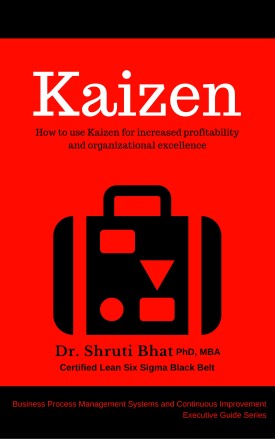
Tip: To know more about how to initiate Kaizen at your company check out my book on How to Use Kaizen for Increased Profitability and Organizational Excellence. If yours is a pharmaceutical or a biotech setup, check out this book Kaizen for Pharmaceutical, Medical Device and Biotech Industries.


Example of Initiating Kaizen in an Engineering Company:

Let’s take an example of initiating Kaizen in an engineering company to improve customer satisfaction.
​
Improving customer satisfaction with Kaizen involves continual, incremental changes focused on enhancing product/ service quality and efficiency. By regularly soliciting and incorporating customer feedback, you can identify and address pain points in the customer journey. Additionally, empowering employees to suggest and implement improvements fosters a culture of customer-centric innovation, leading to higher customer (as well as employee) satisfaction levels.


To get started, a Kaizen champion and taskforce must be established. The Kaizen champion will lead the campaign and he/she will report directly to the company's CEO or the management board. 

The taskforce should include the Kaizen champion, a manufacturing engineer, a design engineer, a quality engineer and two people from the marketing & sales function. In some cases, the team should also include business partners, customers and suppliers to ensure success.

Tip: Besides the Kaizen champion, the Kaizen sponsor aka process owner should also hold overall responsibility for the results of the Kaizen event. So, before you implement Kaizen in your company, first make sure your stakeholders are willing to make it happen.

The Kaizen taskforce must review the current state of the business, product mix, customer base, complaint records etc. and identify the opportunities for improvement. Also, Gemba Walks must be done periodically. I have a separate blogpost on Gemba Walks; you may check it out here. Also, checkout my blogpost on Dos and Don'ts of Gemba Walks here.

Once opportunities of improvement for increasing customer satisfaction are identified by the taskforce, a Kaizen implementation strategy must be designed as well as the execution roadmap.

Remember, the principles of Kaizen emphasize the 'value' of continual incremental improvements. By implementing Kaizen into the company's culture, it can be permanent.

Tip: Make sure that new hires are trained in the principles of the Kaizen process. Also do refresher training periodically for current employees, so that the changes are sustained for years to come.


Kaizen-ing runs via Kaizen events.


Conducting Kaizen Events:

During Kaizen events, the Kaizen taskforce must meet and work together with people at grassroot levels from the sales and marketing function to come up with potential solution(s) to the problem(s).

These meetings should be centered around a specific problem such as- an increase in product returns, defective products, delayed deliveries etc. Also, the meetings must be held in a physical location within the company- the Gemba; in Japanese Gemba means the actual workplace.


Utilizing Digital Tools:

Conducting Kaizen events in the Gemba, that is the actual workplace, allows for a direct, in-depth understanding of the processes and problems. It facilitates real-time observation and problem-solving, enhancing the relevance and effectiveness of continual improvement strategies.

However, physical presence isn't always feasible, for instance, the process is worked at multiple locations of the company, participants can't/ don't want to travel frequently etc. In such cases, the Kaizen champion must hold meetings at Gemba, that is the primary location where the proposed process (for improvement) is being worked. People close to the process must be physically present at the meeting and other stakeholders, process owners etc. can join the meeting virtually.

Tip: It is a myth that virtual Kaizen meetings are not effective. 
Utilizing digital tools like video conferencing, shared digital whiteboards, and real-time data sharing platforms, teams can collaborate, analyze, and brainstorm improvements remotely, maintaining the spirit of Kaizen by adapting to modern, flexible work environments.


Kaizen Tools:

There are over hundred useful tools viz. Value stream map, SIPOC diagram, Spaghetti maps etc. which help in identifying areas of improvement, potential solution(s), implementation, monitoring and sustaining the changes. Also, several change management models are helpful in installing Kaizen smoothly and with minimal disruptions to the business activities. Checkout more about change management models in my video series- Organizational change management.

Moreover, two tools are extremely helpful in Kaizen initiative for increasing customer satisfaction- Kaizen board and Taguchi loss function. 

  1. Kaizen board: The Kaizen board is an excellent place to document ideas for improvements. It helps the Kaizen taskforce to track progress, identify issues, and implement solutions in real-time. The board typically displays tasks, goals, and improvements at various stages of completion.
  2. Taguchi loss function: This is a graphical representation of how an increase in variation within specification limits leads to an exponential increase in customer dissatisfaction.

Along with the Kaizen board, the taskforce often use a template to stay on track to initiate Kaizen in the organization. Using this method, each member of the team contributes towards improving the customer relationship process.


Case Study:

Initiating Kaizen in the above-referred medium-sized engineering company led to remarkable results in various aspects of their operations.

One notable outcome was streamlining the production processes and increasing inventory turns.

The company focused on continuous improvement by involving employees at all levels to identify inefficiencies and propose solutions. As a result, the company saw a 30% reduction in production lead time and a 25% increase in overall productivity.

Quality control improved significantly, with defect rates dropping by 40%.

Additionally, the Kaizen initiative nurtured a culture of collaboration and innovation, leading to enhanced employee engagement and a motivated workforce. These improvements not only boosted the company’s competitive edge but also resulted in substantial cost-savings, higher customer satisfaction and market share. 


Adapting Kaizen to Today's Business Environment:

In today's rapidly changing business landscape, integrating Kaizen with digital transformation initiatives can significantly enhance productivity as well as customer satisfaction.

Digital tools and platforms have made it easier for teams to collaborate in real-time, share feedback instantly, and implement changes more swiftly and efficiently. Also, utilizing data analytics to identify customer pain points and employing automation to streamline processes can amplify the benefits of Kaizen.

Additionally, fostering a culture of continuous improvement through regular virtual training sessions and collaborative digital platforms ensures that, all employees are aligned with the Kaizen principles, even in a remote or hybrid work environment.

Embracing sustainable practices within the Kaizen framework is yet another way to stay relevant. Customers today are increasingly conscious of environmental and social issues. Implementing eco-friendly processes and demonstrating a commitment to corporate social responsibility can enhance customer satisfaction.
Furthermore, in an era where customer expectations are higher than ever, Kaizen's emphasis on small, incremental improvements can help businesses stay agile and responsive.

By continually refining processes and products based on real-time customer feedback, companies can better meet customer needs, enhance their experiences, and build stronger, more loyal customer relationships. This proactive approach not only boosts customer satisfaction but also gives businesses a competitive edge in an increasingly dynamic market.


Conclusion:
Besides improving the customer relationship process, Kaizen also improves employee engagement and overall mojo in the organization. With the right approach, your organization can benefit from increased employee morale and productivity. ​

If you’re looking for a way to elevate customer satisfaction and operational excellence, Kaizen could be the game-changer your business needs. How is your company implementing continuous improvement? Share your thoughts and experiences in the comments!

Remember, the benefits of Kaizen extend well beyond improved customer satisfaction! 

📢 Looking to start Kaizen in your organization? Let's connect! Feel free to reach out to me here.

​​Related reading:
  1. How to cut costs strategically using Kaizen
  2. Streamline processes and workflows with Gemba Walk
  3. Convert business efficiency with Spaghetti models.
  4. Taguchi loss function. ​
  5. How to Use Kaizen for Increased Profitability and Organizational Excellence.

​​Follow Shruti on Twitter, YouTube, LinkedIn
Get In Touch
​Categories:  Leadership | Kaizen | Voice of customer


Keywords and Tags:
#Kaizen #ContinuousImprovement #CustomerExperience #LeanMethodology #BusinessStrategy #ProcessImprovement #EmployeeEngagement #DigitalTransformation #Sustainability #CustomerSatisfaction #ContinualImprovement #OperationalExcellence #PDCACycle #Gembawalks #KaizenEvents #CrossFunctionalTeams #DigitalTransformation #SustainablePractices #Taguchilossfunction  #kaizenchampioncertification   #BusinessGrowth #Leadership #Innovation #QualityManagement #CustomerExperience
0 Comments
<<Previous
Forward>>

    New Book Released!

    Revolutionizing Industries with Lean Six Sigma

    Shruti's YouTube Channel ...

    Picture

    Blog Categories

    All
    3D Printing
    Agile
    Artificial Intelligence
    Automation
    Biotechnology
    Books
    Business Continuity
    Business Turnaround
    Case Studies
    Change Management
    Checklists
    Chemical Industry
    Continuous Improvement
    Design Thinking
    Digitalization
    Drug Delivery
    External News Links
    Hall Of Fame
    Healthcare
    Hoshin Kanri
    HR Development
    Innovation
    Insights
    ISO
    Just In Time
    Kaizen
    Leadership
    LEAN
    Lean Six Sigma
    Life Sciences
    Machine Learning
    Manufacturing
    Medical Devices
    Mistake Proofing
    Motivational Cards
    MSMEs
    Nanotechnology
    Operational Excellence
    OpEx Models
    Packaging
    Patents
    Personal Products
    Process Improvement
    Product Development
    Productivity Increase
    QbD
    Quality Management
    R&D Leadership
    Robotics
    Service Industry
    Six Sigma
    Strategy
    Supply Chain Logistics
    Telecom Industry
    Templates
    TQM
    Videos
    Voice Of Customer
    Whitepaper
    Workshops

    Shruti's books...

    Picture
    top ten strategic decision-making tools for operational excellence
    shruti bhat, business process management, continuous improvement
    kaizen for pharmaceutcials, medical devices and biotech industry book by Dr Shruti Bhat
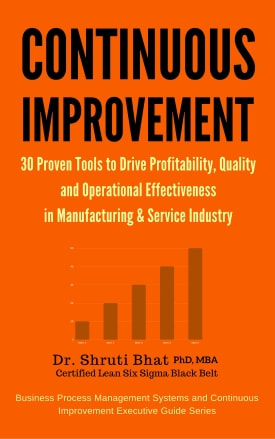
    Book on Continuous improvement tools by Dr Shruti Bhat
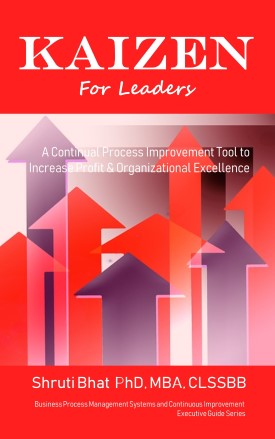
    kaizen for leaders, continuous process improvement tool to increase profit and organizational excellence by shruti bhat
    kaizen, shruti bhat, continuous improvement, quality, operations management
    how to lead a successful business transformation
    leading organizations through crisis
    emotional intelligence
    how to overcome challenges of creating effective teams
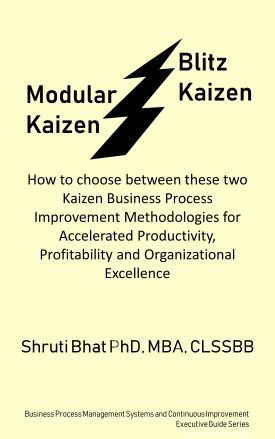
    modular kaizen Vs Blitz kaizen
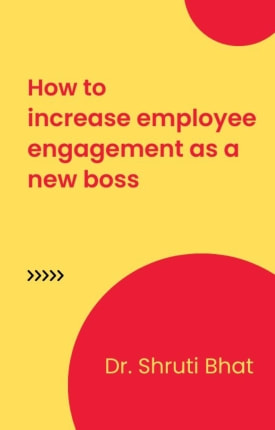
    How to increase employee engagement as a new boss

Connect with Dr. Shruti Bhat at- ​YouTube, LinkedIn​ and X

© Copyright 1992- 2026 Dr. Shruti Bhat ALL RIGHTS RESERVED.
See Terms and Conditions details for this site usage.
Picture
Subscribe to PharmaOps Consulting YouTube Channel
Subscribe to Operational Excellence Academy YouTube Channel
​Subscribe to Operational Excellence Academy YouTube Channel
SHRUTI BHAT, CONTACT
Click to connect.
Disclaimer:
  • All content (and in all formats) provided on this site is for educational purposes only. It does not constitute legal, regulatory, quality, financial, medical or professional advice. If you wish to apply ideas contained on this site, web pages, resources bank, tools and/or blog; collectively referred to as website, you are taking full responsibility for your actions. 
  • No professional-client relationship is created by reading or using this content. 
  • ​To the fullest extent permitted by law, the author(s), Dr. Shruti Bhat and website owner disclaim liability for any loss or damage arising from reliance on the information contained herein. Read full disclaimer here before reviewing the site.
Created by Macro2Micro Media