Shruti Bhat PhD, MBA, Operations Excellence Expert
  • Home
  • Shruti
  • Operational Excellence Hub
  • OpEx Models
  • Writings
    • Process Improvement
    • Business Transformation
    • Innovation Management
    • Leading Research and Development
    • Developer's Diary
    • Business Continuity
    • Change Management
    • Digital Transformation
    • Quality Improvement and Compliance
    • Free eBooks and Whitepapers
    • Checklists and Templates
  • Books
  • Services
    • PharmaOps Consulting
    • Tara LeanWorks
    • Training Services
  • Blog
  • Insights
  • Case Studies
  • Patents
  • Print Publications
  • Videos
  • Contact

How to transform businesses via portfolio management- Part 3

5/1/2022

0 Comments

 
Transforming organization to accelerate growth in this era of post Covid-19 induced crisis features on To-Do list of every business leader. 
reengineer your product portfolio to transform your business
In the previous parts of this article, I had commented briefly on how product portfolio can facilitate successful business transformations. Further product portfolio is built on four pillars-
​
  1. Company’s definition of a new product.
  2. Portfolio project management technique employed.
  3. Product development pathway.
  4. Marketing and Sales process's abilities to gain market share.

Part 1 of this article covered pillar 1- Company’s definition of a new product, while Part 2 covered pillar 2- Portfolio project management techniques employed.

In this part, I shall elaborate on pillar 3- Development pathway.
​
Broadly, new product development can happen via three development pathways namely-
  1. Incremental change.
  2. Copy the competitor.
  3. Disruptive development.

Incremental change development:

In Incremental change pathway, product development happens thru adding one or more features on existing products.
 
In this case the companies see opportunity to sell items or services that are fundamentally like what they’re already selling, but with small changes. For example- an additional size of a mobile phone, a lower strength of a medicinal product, a new flavor of a chewing gum or new fragrance of a toothpaste or shampoo etc.

Copy the competitor:

Copy the competitor pathway is also known as ‘Me- too’ or ‘generics’ pathway.

In this case a best-selling product’s features of an innovator company are copied by other players. If the innovator’s product is under patent, the copy-cat product must be developed by circumventing the enforced patents around the product. A point to note is that generics can be launched only after marketing exclusivity of the original product has matured.

​Generic products offer several advantages to the consumer, for example- a generic product is priced significantly lower than the original product price. Generic products are present in all industry sectors.

Disruptive development:

​The third type of product development happen via disruptive process. In this case companies add entirely new technology to existing products or set up completely new product lines.
 
For example- Apple’s ipod or replacement of meat in frozen meals with plant-based substitutes or a liquid injection offered as a lyophilized powder for reconstitution (to liquid) before administration or drug-products developed via 505 (b)(2) route etc.
 
Underlying this trend is the assumption that companies can exponentially increase customer value by introducing products that match customer’s un-met needs.
 
Incremental change, Me-too and Disruptive development pathways are beneficial both for software as well as physical products, such as- Toys, Cosmetics, Non-medical machinery, Chemicals, Over-the-counter pharmaceuticals, Herbal supplements, Consumer health products, Telecom, Healthcare etc.
 
A point to note is that the rate of adding new features is based on product types. For example- new feature additions are faster for software products than it is for physical products. For example- Social media apps or computer software are tweaked almost every week, which usually occur as auto updates. Such swift changes are unthinkable for physical products be it a machine, chemical, cosmetic or a drug product.
 
However, this can be overcome by focusing on minimum-viable-product design practices and constant iterative improvement, rather than spending years developing a 'perfect' product that could be outdated before it can be launched.
 
So, how can development pathway help transform your business?
 
The Incremental change, Me-too as well as Disruptive development pathways are comprised of several underlying processes.
 
These processes are primarily of two types- Technical processes and business processes. And increase in efficiency and effectiveness of both these types of processes will bring about increase in profit, in turn facilitate business transformation and accelerate growth.

There are more than eighteen scientific and time-tested process improvement methodologies. You can know more about them here.
 
The choice of process improvement methodologies is dependent on multiple factors such as- process type, product type, organizational size etc. 
​Usually, process improvements of technical processes (regardless of industry sector) can be successfully accomplished with Poka Yoke, DFM, Hoshin,  Design Thinking, TRIZ, Agile, DFSS methodologies.

​While improvements of business processes can be successfully achieved via Lean, Kaizen, Six Sigma, ISO, CMMI, TQM, Kanban etc.
​Using a combination of 2 or 3 process improvement techniques in strategic ways gives the best and fast ROI.
 
In the next part of this article, I shall discuss the fourth portfolio parameter impacting successful business transformations- Marketing and Sales process's ability to gain market share.
​
By the way, if you run a company that is facing a challenge to thrive in these difficult times, I would suggest that you please revisit your product portfolio in order to bring a quick turnaround.
Get In Touch
Follow Shruti on Twitter, YouTube, LinkedIn

Related reading:

  1. How to transform businesses via portfolio management- Part 1
  2. How to transform businesses via portfolio management - Part 2
  3. How to transform businesses via portfolio management- Part 4
  4. How to cut costs strategically using Kaizen
  5. Idea Management: Master key to innovate and capture profit.
Keywords and tags:
​
#businesstransformation #businessturnaround #kaizen #lean #TRIZ #DFSS #pokayoke #hoshin #DFM #TQM #ISO  #portfoliomanagement #continuousimprovement #businessprocessimprovement #processreengineering #processimprovement #processefficiencyimprovement #newproductdevelopment #processeffectiveness #transformingorganizations  #howtodobusinesstransformation #howtoimprovebusinessefficiency 
0 Comments

How to transform businesses via portfolio management - Part 2

4/29/2022

0 Comments

 
Transforming organization in this era of post Covid-19 induced crisis features on To-Do list of every business leader. 
reengineer your product portfolio to transform your business
​In the previous part of this article, I had commented briefly on how product portfolio can facilitate successful business transformations. Further, product portfolio is built on four pillars-
​
  1. Company’s definition of a new product.
  2. Portfolio project management technique employed.
  3. Product development pathway.
  4. Marketing and Sales process's abilities to gain market share.

Part 1 of this article covered pillar 1- Company’s definition of a new product. 

​In this part, I shall elaborate on pillar 2- Portfolio project management technique.

Portfolio project management technique plays the role of a gear in the overall portfolio management. Its function starts right from identifying new products for the portfolio, thru product development & launch and ends after completing post launch product review. Several project management techniques such as- Waterfall, Critical path method (CPM), Event chain methodology (ECM) etc. are being used by companies regularly and they have been effective too.

But in times when a business is going through a cash crunch or market challenges or a pandemic induced crisis, then along with an effective, a super efficient project management technique is needed.

Some of such effective and super efficient project management techniques are- Agile, RACI and Kanban.

Agile:

​Agile, as the name suggests, improves efficiency of processes underlying project management. This helps with maintaining project’s time-cost-scope balance and products get launched faster. However, Agile technique has few limitations, that is, Agile cant be used in all industry sectors. For example, Agile can’t be implemented in Biopharma, Airline and few other industry sectors. You can read more about Agile here.

RACI:

RACI is an acronym for Responsible, Accountable, Consulted and Informed. Responsible refers to the individual that is executing the activity. Accountable refers to the person who makes authority decisions and approves work. Consult refers to the individuals that are consulted when activities or decisions are being made or analyzed. Inform refers to the group of people who must be updated on the actions or decisions in a process. 
​
RACI is a beneficial tool for making sure that roles and role responsibilities within a project are clearly defined in its underlying operational process.  Unlike Agile, RACI project management technique can be used by all industry sectors. You can read more about RACI here

Kanban:

​Another important efficient project management technique is Kanban. Kanban is a Japanese process improvement technique.

When Kanban is integrated into the project management process, it augments the process’s efficiency as well as effectiveness. Therefore, Kanban based projects run faster and cheaper when compared to traditional techniques such as Waterfall, CPM, Scrum etc. or for that matter even Agile.

Kanban is a vast topic. If I were to write more about Kanban here, perhaps I shall digress from the spirit of this article. Hence, if you would like to know more about Kanban and how to use it for transforming your business, put a comment below this post and I shall write a separate blogpost on Kanban Project Management.

But I shall write few lines more on Kanban here only to emphasize its importance and benefits in portfolio project management.

Kanban has three striking advantages namely-
  1. Kanban can be used in ALL industry sectors.
  2. Kanban can be used in small as well as big organizations, as against Agile, which shows implementation challenges in large set-ups.
  3. Kanban based project management shows up to 20% savings versus Agile. And this can be augmented further by integrating Kanban with RACI.

Hence, if you wish to develop and launch more products, fast, with less dollar inputs, then Kanban-based portfolio project management is the way to go …

In the upcoming parts of this article, I shall discuss the remaining two portfolio parameters (i.e. product development pathway and sales process ability to gain market share) impacting successful business transformations.

By the way, if you run a company that is facing a challenge to thrive in these difficult times, I would suggest that you please revisit your product portfolio in order to bring a quick turnaround.
Get In Touch
Follow Shruti on Twitter, YouTube, LinkedIn

Related reading:

  1. How to transform businesses via portfolio management- Part 1
  2. How to transform businesses via portfolio management- Part 3
  3. How to transform businesses via portfolio management- Part 4
  4. How to cut costs strategically using Kaizen
  5. Idea Management: Master key to innovate and capture profit.
  6. Streamline processes and workflows with Gemba Walk
Keywords and Tags:
​
#businesstransformation #businessturnaround #projectmanagement #agile #RACI #kanban #portfoliomanagement #continuousimprovement #businessprocessimprovement #processreengineering #processimprovement #processefficiencyimprovement #processeffectiveness #transformingorganizations #transformingbusinesses #newproductportfolio #howtodobusinesstransformation #howtoimprovebusinessefficiency 
0 Comments

How to transform businesses via portfolio management- Part 1

4/27/2022

0 Comments

 
Transforming organizations in this era of post Covid-19 induced crisis features on 'To-Do' list of every business leader. ​
reengineer your product portfolio to transform your business
The magnitude and extent of the transformation task will be different depending on the organization’s size, industry sector, market demographics, product mix etc.

​
​Product mix or product portfolio is one of the important parameters impacting successful business transformation. 
​If you run a company that is facing a challenge to thrive in these difficult times, I would suggest that you please revisit your product portfolio in order to bring a quick turnaround.
In this blog article, I shall briefly touch upon how to bring about business transformation by building a profitable product portfolio.

Simply put, a profitable product portfolio is built on four pillars-
​
  1. Company’s definition of a new product.
  2. Portfolio project management technique employed.
  3. Product development pathway.
  4. Marketing and Sales process's ability to gain market share.

Note that the above four parameters are inter-dependent, meaning any change in one parameter will have a direct synchronistic impact on the other three, which in turn directly impacts revenue gains.

So, without further ado, let us delve into them one-by-one…

1.  Company’s definition of a new product:
The meaning of ‘new’ product is different for different organizations. Even within the same industry sector, what comprises a new product is different for different companies. Therefore, to build a profitable product portfolio, it is vital that each company clearly mentions what comprises a ‘new’ product for that company.

The path to building a successful product portfolio commences with defining what constitutes a ‘new’ product for the organization.

Broadly stating (regardless of industry sector), companies classify a new product into following nine categories-
  1. The product has at least one unique selling point (USP) such as- new technology, new use, un-met customer need, better shelf-life etc.
  2. Product is handled by a new SKU or has a new bar code.
  3. Product is new to the world.
  4. Product is new to the company.
  5. Product is new to the company’s market.
  6. Repositioned product viz. new applications for existing product or re-targeting an old product to a new market.
  7. Cost-reduced (existing) product.
  8. Improvements & modifications to existing product, including line extensions.
  9. Patentable product.

Categories 1 to 8 are pretty much self-explanatory, so I shall head straight to category 9- Patentable product.

A patentable product as the name suggests, is an item that can be patented, where the item can be a product, process or a design.

A likely question is- What’s so special about patentable products? Well, it is special because a patent offers monopoly to the patent owner. The patent term is usually up to 20 years. Also, patented products can get marketing exclusivity from 3 to 20 years depending on product type, industry sector etc.

So, if the marketing exclusivity tenure is same as the patent term, it means that there will be no competitor to worry about for twenty years!

Having said that, it must be noted that once exclusivity term ends, generic competitors can pitch-in. Hence stronger the originator patent, difficult it will be for the generics to enter the market. Further, note that all new products cannot be patented, because patentability is established when a product, process or design meets patent eligibility criteria set out by the Patent Act of the country in which the product is sold.

Therefore, more the number of patented products in your product portfolio, faster & higher will be the ROI.

Moreover, the product portfolio is always a mix, meaning products belonging to two or more of above- referred categories are present in the portfolio. Depending on the category of the ‘new’ product, it will require resource inputs such as- budget, talent pool, development time etc.

Hence, a strategic selection and right mix of new products will determine a business’s resilience to thrive through difficult times. It will also determine the extent of success with business transformation of struggling companies.

Note that, the goal of portfolio management is to reduce complexity and identify product differentiation characteristic which offers ‘value’ to the customer. This is more so when organizations face crisis conditions such as material shortages, delays due to supply chain disruptions, pandemics etc.

By adding the right transformation tools and processes, companies can actively shape a simple, value-based and profitable product portfolio that can both reduce the burden of risk management now and better serve customers once the crisis eases.
​
In the upcoming parts of this article, I shall discuss on the remaining three portfolio parameters impacting successful business transformations and how to go about positively transforming your business.
Get In Touch
Follow Shruti on Twitter, YouTube, LinkedIn

Related reading:

  1. How to transform businesses via portfolio management - Part 2
  2. How to transform businesses via portfolio management- Part 3
  3. How to transform businesses via portfolio management- Part 4
  4. How to cut costs strategically using Kaizen
  5. Idea Management: Master key to innovate and capture profit.
  6. Streamline processes and workflows with Gemba Walk
Keywords and Tags:
​
#businesstransformation #businessturnaround #strugglingcompany #sickunit #portfoliomanagement #continuousimprovement #businessprocessimprovement #processreengineering #processimprovement #processefficiencyimprovement #processeffectiveness #transformingorganizations #transformingbusinesses #newproductportfolio #howtodobusinesstransformation #howtoimprovebusinessefficiency 
0 Comments

9 Key areas for businesses to bring new products fast to market.

10/13/2021

0 Comments

 
​First-mover advantage is the ultimate aim behind any new product development. Unlike popular belief, new product development is not the sole responsibility of R&D division. Other functions also play a major role in development and introduction of new products to market. In fact, new product development is an end-to-end process, involving several departments across the organization.

​And, this process must be super efficient in order to ensure high returns on investment (ROI) from new product development.

So, what are the factors that make a positive impact in bringing new products fast to market? Checkout this video to know more about- 9 Key areas for businesses to bring new products fast to market.

This video belongs to my YouTube video series- One-minute guide to continuous improvement where I explain various topics related to continuous improvement for operational excellence and business growth. 

​Watch on ...
Are you ready to implement Continuous Improvement at your organization?
Get In Touch
Follow Shruti on Twitter, Facebook, YouTube, LinkedIn

Related videos:

  1. One minute continuous improvement guide series.
  2. Kaizen explained with examples and case studies.
Keywords and Tags-

​#newproductdevelopmentprocessimprovement #continuousimprovement #kaizen #agile #firstmoveradvanatge  #innovationmanagementprocessimprovement  #agileproductdevelopment  #businessprocessimprovement
0 Comments

Idea Management: Master key to innovate and capture profit.

4/7/2021

0 Comments

 
idea management_ master key to innovate and capture profit
​Idea Management is an important and integral part of Innovation Management. There are two schools of thought about idea generation and its management. First, out-of-the box thinking and second, inside-the-box thinking.  

​Out-of-the-box thinking as the name suggests is seamless creativity. While inside-the-box thinking means there is a boundary within which ideas are generated and managed. Wider the boundary, deeper gets the creativity.

And if more ideas have to grow from being on paper to becoming a commercialized product, inside-the-box thinking is the way to go.

​Because, for a business there is a budget to follow, expenses to limit, ROI to gain and investors to take care of. Every penny spent on innovation is accounted for i.e. where profits aren’t earned, the R&D expenditure gets written-off. And the objective is always to get the most out of the buck.

Inside-the-box thinking essentially means, innovation is done with a target product profile in mind. The aim is to generate large number of ideas to maximize number of potential ideas-to-product pathways. The picture below depicts innovation management via inside-the-box idea generation.
​
Once an idea qualifies for becoming a new product candidate, it must successfully pass through the various stages of product development thru obtaining market approval and subsequent launch, to find its crown in the marketplace.
innovation management via inside-the-box idea generation
Innovation Management
As you will note from the above picture, not all ideas gain ‘new product candidate’ status. So, what happens to the ideas, that do not get selected. Do they get dumped permanently? The answer is No.
​
Let's analyze the ideas further- Usually, ideas get rejected because of three main reasons-

a. Technically idea commercialization is not possible.
b. Profit wise the ideas are not feasible.
c. The company is not keen to go for such a new product at this point of time.
​
​Hence, let's first segregate the rejected ideas into three buckets as per the above classification and then review them one-by-one.

A. ​Technically idea commercialization is not possible.

​Ideas that are not technically feasible now can become great candidates later.

​A classic example of this is Sildenafil citrate tablet. This drug candidate was first evaluated as a treatment for chest-pain. Later, the company found an alternate use of the drug candidate and channeled this molecule thru the development pipeline to launch as Viagra- rest is history!
​

B. ​Profit wise the ideas are not feasible

​The second lot comprises of those ideas that seem not feasible in terms of profitability. Meaning technically, they may be good, but cannot be commercialized because of high cost.

​One of the classic example for this is- the Microwave oven.

Microwave oven was first invented in the 1940s, around world war II era. The first commercialized microwave oven was huge, weighing 750 pounds and costed $2000 USD. Obviously, it did not sell well.

The company worked on the technical aspects and the first domestic microwave was introduced in 1955. And that did not sell too. After many design changes, microwave oven gained access to our homes in 1967 and by 1975, they were in full demand.

A point to note here is that microwave oven invention was both accidental and EVOP (Evolutionary Operation) product development. Also, note the development timeline, from 1940 to 1955 to 1967 to 1975. i.e. 27 to 35 years from being an 'idea' to 'profitable' commercialization!

It is well-known that EVOP drains money. To avoid such bleed, concept of Innovation Management took shape. I shall be writing more about innovation management in a separate blogpost. For now let us visit the third lot of rejected ideas.
​

C. ​Company is not keen to go for such a new product at this point of time:

Now, let us consider the third lot of ideas- those ideas which the company is not keen to go for at this point of time.

​
Such ideas must be worked upon in the lab to develop a small prototype. While prototyping, ensure that you build-in anti-counterfeit measures in your product. Then file a provisional patent application to stake claim to your idea and simultaneously block competition.
​
After filing a provisional patent application, you have 12 months to file final PCT patent specification. Additionally, you get thirty months (from date of priority filing) to enter national phase i.e. do national phase patent applications in the PCT countries of your choice.

Hence, the company gets close to 30 months to scout for buyers who would be interested to license your product. Since a prototype as well as the patent is available (for the invention), you stand to gain better licensing fees at the negotiation table.

Also, resources need not be pumped-in immediately, as product development, process validation, scale-up and other related activities can take place over 12 to 30 months timeframe. This has dual advantages- first, R&D budget can be better managed, and second, R&D infrastructure can be better utilized.

Moreover, provisional and/or final PCT patents being intellectual property can be mortgaged on a short-term basis to banks or other financial institutions, to secure funds which in turn may be pumped-in to conduct research work or use it for other areas of the business.
​
The philosophy of Innovation Management is to ensure, every penny spent on R&D must bring-in good return on investment (ROI) both in terms of profits and company reputation.
​
The goal of Innovation Management is to turn ideas into profit, block competition and stop counterfeits.
​

​There are multiple pathways for conducting idea and innovation management successfully. The content presented above is one such pathway.

Also, the choice of idea and innovation management pathways depend on various factors such as- industry vertical, product mix, operating markets, corporate goals and more. Therefore, selecting the best pathway which will yield faster ROI with a first-mover advantage is crucial. 

Your choice of idea and innovation management pathway and its flawless execution will determine your business's very existence, growth and resilience.

An important question to introspect is- Are you building an idea and innovation management strategy which is the best for your organization?

​To know more about how idea-innovation management can help your company expand its product offerings, increase profit and earnings per share for investors, reach out to Shruti.

​Related Reading:​
  1. Disaggregate between being lucky and being good in business: Portfolio Management and Continuous Improvement are the two winning tools in the new normal …
  2. 8 Steps to becoming a Customer- centric organization
  3. Dos and Don’ts Of Rapid Innovation
  4. How to transform businesses via portfolio management- Part 1
  5. How to cut costs strategically using Kaizen

Follow Shruti on Twitter, Facebook, YouTube, LinkedIn

Categories:  Innovation Management | Operational Excellence

Keywords and Tags:
​​#innovationmanagement #patent #ideamanagement #stopcounterfeits  #blockcompetition
Get In Touch
0 Comments

Accelerate business growth with Agile Part 2: Top 10 Frequently Asked Questions on Agile.

2/1/2021

0 Comments

 
In the first part of this article, I touched upon what is Agile methodology, which industry sectors use it and some dos and don’ts for Agile.
Accelerate business growth with Agile part 2_ top 10 frequently asked questions on Agile
​In this part I shall discuss top 10 frequently asked questions around Agile. By the way, these questions have been taken from my blog reader’s feedback which I regularly receive as direct messages or queries. If you too have questions, please hit the ‘Get-in-touch’ button at the bottom of this blogpost and send me your thoughts …
 
So, let’s begin with top 10 frequently asked questions on Agile business improvement methodology.

FAQ 1: Is Agile good for Startups?

​Agile business process improvement methodology is a proven concept to transform or turnaround businesses. Its ability to unlock value has been pressure-tested in different industry sectors belonging to manufacturing as well as service-based setups. Agile is extensively beneficial to startups. A startup could be a new company or a new function or department within an existing company.

FAQ 2: Is Agile only for IT department?

​Agile concept emphasizes team collaboration and flexible reassessment of plans based on customer feedback. Agile can be applied to all departments. Agile was first used in the software development and is popular within the IT sector. But since Agile offers fast return on investment, it is gaining popularity in other sectors as well.

FAQ 3: Can we introduce Agile in our organization?

​The correct answer to that question is- May be. Because, although Agile can be applied in any industry, it must not be applied blindly. Agile must be applied only after a due diligence around how it would be applied, what benefits it shall bring-in for the organization etc is done. Further, there are several Agile methodologies. One must take cognizance of this and choose the Agile methodology most suitable for your workplace.

FAQ 4: Is there a difference between Agile and other process improvement techniques such as Lean, ISO, Kaizen etc.? 

​There are several differences. But the most striking difference is that Agile cannot/ must not be applied in the same way across the entire organization. Different sections of an organization benefit from Agile in varying ways. The benefits can be optimized or increased based on the results of blueprinting i.e. identifying the value streams and investigating how each section of the value stream can benefit from Agile, provides valuable input in Agile- based business transformation.

FAQ 5: Are Agile and Scrum same?

​Agile is not same as Scrum. Agile is a wide concept, Scrum is a type of Agile method.  Scrum is one of the many dynamic Agile methods and emphasizes team collaboration and flexible reassessment of plans for bringing about business transformation.

FAQ 6:  Agile scale-up is costly and requires large teams.

​Scaling-up Agile has similar challenges as scaling-up any other process improvement methodology. Simply having more teams or conducting more dry runs are not enough. Further, expenses towards Agile scale-up must be factored in the budget before embarking on Agile. My best recommendation is to never begin any process improvement campaign without first doing a cost-benefit analysis.

FAQ 7: How is Agile project management different from traditional Waterfall technique during product development?

​There are several differences, but I shall highlight only two main differences here. Since Agile was initiated in software business, let me explain this question using software development as an example.
 
The first main difference is that- When Agile is used in product development, in this example a software, features of the software are delivered frequently, and the testing is done in parallel to development. As a result, testing time is shortened because only small features are need be tested at a time. On the contrary, in the Waterfall methodology, testing take place at the end of the development. As a result, testing time gets lengthy as the entire product must be tested.
 
The second difference is that- Waterfall methodology is a closed process where all stakeholders are not involved in the development activity. In Agile methodology, active participation of all stakeholders as well as customers is a must.
 
Although Agile is traditionally being used in software development, it can be applied for any product development be it- toys, food, chemicals, devices, cosmetics, apparel, electronics, services etc.
 
Agile is especially beneficial for product development where frequent changes in the product come up on a regular basis.

​FAQ 8: Can Agile increase productivity?

​Speed and flexibility are two key advantages of Agile methodology. This aspect improves employee engagement, collaboration between teams internal and external to the organization which then boosts output. Agile implementations increase productivity as well as ‘value creation’. In fact, Agile’s strength is in 'value creation' rather than fixing crawling productivity. Therefore, if you are looking to create value, go for Agile. If addressing productivity issues is the sole aim, then go for Lean or Kaizen.

FAQ 9: Why is Agile so popular?

There are multiple advantages of utilizing Agile in organizations. Versatility and speed are two of its key benefits. Further, when applied to R&D business processes, Agile accelerates product development; companies can then achieve first-mover advantage. Also, Agile maximizes value throughout the development process and significantly reduces the overall risk of a project. 

FAQ 10: What are the limitations or disadvantages of Agile methodology?

Agile must be applied after due diligence.
 
First important limitation of Agile implementation is that- Agile is rapid at small scale; but scaling up takes time. A company-wide full-scale Agile implementation takes 1 to 3 years depending upon the nature and size of business. Therefore, Agile is not for weak-hearted setups.
 
Secondly, Agile is unpredictable with regards to effort planning.  Hence, Agile project planning must be done with caution.
 
Thirdly, Agile is all about being fast- to- market with a product designed as per customer demand. Hence, the mechanism of collecting voice of customer and its interpretation must be flawless. However, combining Hoshin Kanrii with Agile helps to circumvent this issue in a big way.
 
Lastly, Agile methodology has minimal documentation. No elaborate reports etc. Usually, simple burn up and burn down charts are used for documentation purposes. Burn up and burn down charts are visual diagrams which measure a project and show its progress, schedule, status and any outstanding work. If creating and distributing bulky reports is part of an organization’s work culture, then it needs to adapt to a major change if hoping to work with Agile. This must be factored-in while designing change strategy before proceeding with Agile.

In the next part of this article, I shall discuss on how to use Agile to improve business resilience.
Get In Touch
Follow Shruti on Twitter, Facebook, YouTube, LinkedIn

Related reading-

  • Business Turnaround and Continuous Improvement Tips & Tricks Part 3 of 6- Agile in Nutshell for Improving Sales & Marketing of Products and Services
  • Improving business process effectiveness and efficiency for the new normal.
  • ​What is the difference between business process improvement and business process redesign?​
Keywords and Tags:

​​#Agile  #AgileProductDevelopment  #BusinessTransformation #AgileFAQ #Scrum #ProjectManagement #WaterfallProjectManagement #AgileProjectManagement #ResearchandDevelopment  #AgileForProcessImprovement  #StrategyBuilding  #ImplementingAgileFramework  #ChangeManagement
0 Comments

Use Strategic QbD to improve Business Resilience

1/27/2021

0 Comments

 
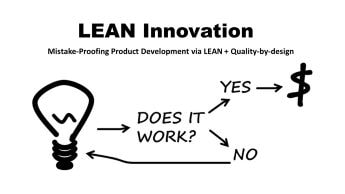
Concept wise Quality-by-Design or QbD is not new. The word quality-by-design was introduced by Juran in his work on quality management. And since then organizations have used QbD to introduce quality aspect into products and services.
​
However, in my view QbD is a holistic concept for business improvement and has not been fully explored to its full potential. It can do much more than just build-in quality. In the video below, I have touched upon how QbD can improve business resilience. Watch on…
Follow Shruti on  Twitter, YouTube, LinkedIn

Related reading:

  • How to cut costs strategically using Kaizen
  • Quality-by-Design (QbD) approach means Design for Manufacturing (DFM)
  • Business Turnaround and Continuous Improvement Tips & Tricks Part 5 of 6: TQM in a Nutshell

Keywords and tags:
​#Qualitybydesign #Businessresilience #Juran #QualityManagement #AgileKaizen #DesignThinking #DesignSpace #ProductDevelopment #QbD #BusinessTransformation
0 Comments
<<Previous
Forward>>

    New Book Released!

    Revolutionizing Industries with Lean Six Sigma

    Shruti's YouTube Channel ...

    Picture

    Blog Categories

    All
    3D Printing
    Agile
    Artificial Intelligence
    Automation
    Biotechnology
    Books
    Business Continuity
    Business Turnaround
    Case Studies
    Change Management
    Checklists
    Chemical Industry
    Continuous Improvement
    Design Thinking
    Digitalization
    Drug Delivery
    External News Links
    Hall Of Fame
    Healthcare
    Hoshin Kanri
    HR Development
    Innovation
    Insights
    ISO
    Just In Time
    Kaizen
    Leadership
    LEAN
    Lean Six Sigma
    Life Sciences
    Machine Learning
    Manufacturing
    Medical Devices & Prosthetics
    Mistake Proofing
    Motivational Cards
    MSMEs
    Nanotechnology
    Operational Excellence
    OpEx Models
    Packaging
    Patents
    Personal Products
    Process Improvement
    Product Development
    Productivity Increase
    QbD
    Quality Management
    R&D Leadership
    Robotics
    Service Industry
    Six Sigma
    Strategy
    Supply Chain Logistics
    Telecom Industry
    Templates
    TQM
    Videos
    Voice Of Customer
    Whitepaper
    Workshops

    Shruti's books...

    Picture
    top ten strategic decision-making tools for operational excellence
    shruti bhat, business process management, continuous improvement
    kaizen for pharmaceutcials, medical devices and biotech industry book by Dr Shruti Bhat
    Book on Continuous improvement tools by Dr Shruti Bhat
    kaizen for leaders, continuous process improvement tool to increase profit and organizational excellence by shruti bhat
    kaizen, shruti bhat, continuous improvement, quality, operations management
    how to lead a successful business transformation

    leading organizations through crisis
    emotional intelligence
    how to overcome challenges of creating effective teams
    modular kaizen Vs Blitz kaizen
    How to increase employee engagement as a new boss

Connect with Dr. Shruti Bhat at- ​YouTube, LinkedIn​ and X

© Copyright 1992- 2026 Dr. Shruti Bhat ALL RIGHTS RESERVED.
See Terms and Conditions details for this site usage.
Picture
Subscribe to PharmaOps Consulting YouTube Channel
Subscribe to Operational Excellence Academy YouTube Channel
​Subscribe to Operational Excellence Academy YouTube Channel
SHRUTI BHAT, CONTACT
Click to connect.
Disclaimer:
  • All content (and in all formats) provided on this site is for educational purposes only. It does not constitute legal, regulatory, quality, financial, medical or professional advice. If you wish to apply ideas contained on this site, web pages, resources bank, tools and/or blog; collectively referred to as website, you are taking full responsibility for your actions. 
  • No professional-client relationship is created by reading or using this content. 
  • ​To the fullest extent permitted by law, the author(s), Dr. Shruti Bhat and website owner disclaim liability for any loss or damage arising from reliance on the information contained herein. Read full disclaimer here before reviewing the site.
Created by Macro2Micro Media