Shruti Bhat PhD, MBA, Operations Excellence Expert
  • Home
  • Operational Excellence Hub
  • About Shruti
  • Insights
  • Writings
    • Process Improvement
    • Business Transformation
    • Innovation Management
    • Leading Research and Development
    • Developer's Diary
    • Business Continuity
    • Change Management
    • Digital Transformation
    • Quality Improvement and Compliance
    • Free eBooks and Whitepapers
    • Checklists and Templates
  • Books
  • Blog
  • Services
    • PharmaOps Consulting
    • Tara LeanWorks
    • Training Services
  • Case Studies
  • Patents
  • Print Publications
  • Videos
  • Contact

Why to link manufacturing training to business goals?

11/14/2023

0 Comments

 
Why to link manufacturing training to business goals?
A question I often get asked by CEOs is how important is it to link manufacturing training to our business goals?

And here's what I've got to say-

To achieve the business goals, linking them to manufacturing operations training is a must. Only then can the organization strategically align the entire workforce to achieve operational excellence.

There are three main benefits to linking training with goals, namely- firstly, training empowers employees and motivates them to do their best at work. Also, there’s enhancement of skills which ensures that employees operate machines safely, optimally leading to workplace safety, decreased equipment downtime and increased productivity. This goes in line with the business’s goals of increasing output while decreasing costs.

Secondly, well-trained employees have a solid grip on the production process. This ensures that the process output is of consistent quality, so no rejects or rework, thus further increasing manufacturing efficiency and decreasing production overheads. Quality products also ring in customer satisfaction and repeat sales.

Training employees with the latest manufacturing technology and operational excellence tools further motivates them to innovate and/or suggest ways to improve existing processes, thus cutting costs.

Last but not the least, motivated employees have higher job satisfaction. So lower turnover and skill drain. Highly motivated employees can do wonders for their organization. For example, they can increase customer satisfaction leading to increased sales and the company can achieve brand leadership.

Training is not just skill development. It is a vital tool for employee engagement, employee retention, enhancing productivity as well as to foster innovation. Linking training to business goals will take your organization on the path of operational excellence and market leadership.

Contact us and we can help you strategize an optimal training program which will get you the best ROI.

Related Reading:​
  1. Top Ten Strategic Decision-Making Tools for Operational Excellence
  2. Popular Continuous Improvement Workshops & Webinars for Manufacturing Industries
  3. What is Machine Learning?
  4. Popular Continuous Improvement Tools.

Follow Shruti on Twitter, YouTube, LinkedIn

Categories:   Process Improvement | Operations | Manufacturing

Keywords and Tags:
#DrShrutiBhat #ProcessImprovement #ProcessExcellence  #ContinuousImprovement #OperationalExcellence #ManufacturingEfficiency
Get In Touch
0 Comments

Harnessing the Power of AI in Project Management

11/9/2023

0 Comments

 
Harnessing the Power of AI in Project Management
Introduction

In today's fast-paced and data-driven world, organizations are constantly seeking ways to improve their processes to increase operational excellence.

Hence, regardless of industry sector, process improvement projects are on the rise, thus keeping project management teams super busy. Therefore, like any other department in an organization, for project management function too, continuous improvement is vital.

One of the key continual improvements in the project management function is digitalization. Traditional project management approaches have served us well. But the rise of artificial intelligence (AI) application in project management is recalibrating the landscape of process improvement campaigns.

Today, AI is not just a buzzword; it's a revolutionary driving force that is set to transform how we plan, execute, and monitor process improvement initiatives. In this blog post, I shall delve into the profound ways AI is redefining management of process improvement projects, and why it's essential for businesses to embrace this transformative technology.

1. Data-Driven Decision Making
AI's primary strength lies in its ability to analyze vast amounts of data quickly and accurately. In management of process improvement projects, this translates to data-driven decision making. You may want to checkout Top ten decision-making tools for operational excellence here.

AI can sift through historical project data, identify patterns, trends and provide actionable insights. This empowers project managers to predict potential roadblocks, make informed decisions and optimize project management effectively, which results in efficient and successful project outcomes. Also, the process improvement projects get handled successfully, within the scope- cost- time outline.

2. Predictive Analytics
Predictive analytics is one of the most exciting AI applications in process improvement project management. AI can forecast potential bottlenecks, resource constraints as well as project risks based on both historical data and real-time information. This facilitates project managers to proactively address challenges before they become major setbacks. By utilizing AI's predictive capabilities, organizations can stay one step ahead in managing projects effectively and efficiently.

3. Automation and Efficiency
AI is a game-changer when it comes to automating routine tasks, especially the repetitive and time-consuming activities. Hence, such activities which tend to bog down project workforce and drain efficiencies can now be assigned to AI-powered tools and bots. This will free-up valuable time and resources for the project team, that can be redirected towards higher-value project management tasks. Automation will ensure that project management processes will run smoother and more efficiently, reducing the risk of human error.

4. Enhanced Resource Allocation
One of the critical aspects of project management is resource allocation. AI can assist in optimizing resource allocation by analyzing project requirements, workforce skills, capability, and availability. It ensures that the right people get assigned to the right tasks, thus improving project efficiency, and ultimately leading to cost savings. Additionally, AI can help to identify over- or underutilized resources, and enable better skill governance and workforce management.

5. Real-Time Monitoring and Reporting
AI-driven dashboards provide real-time monitoring and reporting capabilities, empowering project managers to track progress, identify deviations, and take corrective actions promptly. This level of visibility into project performance enables project managers to make on-the-fly adjustments (without any scope creep), ensuring that projects stay on track and meet their objectives.

6. Personalized Insights
AI can provide personalized insights and recommendations to individual project team members, offering guidance on their specific tasks and responsibilities. This not only improves productivity but also prevents oversight. Also, it motivates the project team and enhances collaborative working. In fact, each team member can create a tailored roadmap for their contribution to the project's success and growth.

7. Risk Management
Risk management is one of the key aspects of effective project management and AI’s ability to swiftly analyze huge amounts of data facilitates in comprehensive risk assessments early on. This allows project managers to take proactive measures at risk mitigation and prevent chances of potential project failures. Further, AI can suggest suitable risk mitigation strategies based on historical data and predictive analytics, thus increasing the likelihood of successful project outcomes.

Conclusion
The impact of AI on management of process improvement projects is undeniable. AI has transformed the way projects are handled end-to-end. From data-driven decision-making to predictive analytics, automation, and personalized insights, AI has equipped project managers with the tools they need to succeed in their tasks. And as AI continues to advance in its role, its impact on project management will get more profound. Therefore, organizations that embrace AI and incorporate it into their project management best practices will gain a competitive edge, delivering higher quality projects more efficiently.

AI is no longer the future; it's the present, and those who harness its power will lead the way in operational excellence.


​Related Reading:​
  1. Top Ten Strategic Decision-Making Tools for Operational Excellence
  2. Popular Continuous Improvement Workshops & Webinars for Manufacturing Industries
  3. What is Machine Learning?
  4. Popular Continuous Improvement Tools.

Follow Shruti on Twitter, Facebook, YouTube, LinkedIn

Categories:   Process Improvement | Operations | Digitalization

Keywords and Tags:
#DrShrutiBhat #ProcessImprovement #ProcessExcellence  #ContinuousImprovement #OperationalExcellence #ProjectManagement #AI #Digitalization #DigitalTransformation
Get In Touch
0 Comments

Theory of Constraints: 5 Steps to reduce lead time!

11/9/2022

0 Comments

 
the theory of constraints_5 steps to reduce lead time!
The theory of constraints (TOC) is a management method that helps companies understand & improve their processes and the business's operational excellence.

At the same time, you will improve profitability and improve the performance of your company. If you are experiencing a bottleneck, the theory of constraints is an excellent solution. It is a systematic approach for solving complex problems.

The theory of constraints is a systematic approach to logistics analysis, and its strategies emphasize efficient decision-making. It has five steps that help you improve your processes. You must first agree on your problem and the constraints that are causing it. Once you have agreed on the constraints and what needs to be improved, you can then move on to the next step.

The
 method is based on the concept that a system consists of a series of interdependent processes. This theory identifies the bottleneck or weak link in the system’s processes. In this way, it helps in process improvement, especially to reduce lead times.
 
By following the 5 Steps, you can create a comprehensive plan for improving your business processes and achieving your goals. You'll find the steps to implement the theory much easier. You begin by identifying the bottleneck, but this can be a difficult task. It is important to realize that there are many variables in a system. 

The five steps of theory of constraints make it a powerful tool for any business. Ultimately, using this method can help you improve your business processes and increase profits. I have a separate post on What is theory of constraints and what are its principles. You may check it out here.

Theory of constraint's five steps to improve productivity:
 
The first step is to identify your weak link and prioritize the activities that will help you improve your process. Your goal is to increase throughput by identifying the weak link and concentrating on resolving it. This process can improve your company's productivity by eliminating waste. In addition, it can reduce lead times and work-in-process.
 
The second step is to exploit the constraint. This step is essential for improving the efficiency of processes. It is important to realize that a constraint does not need to be a permanent one. You should find ways to exploit it so that your system can operate at its maximum capacity.
 
The third step involves eliminating the bottleneck. The bottleneck can be external or internal. For example, it could be a competitor or an influential force in the market or a low-speed machine etc. In either cases, you must identify and exploit the bottleneck. By implementing an improvement strategy, you will increase throughput.
 
After you identify your constraint, the fourth step is that you need to improve the capacity of all other systems in the system. The rest of the system needs to support it and provide a buffer of safety stock to prevent it from being overloaded.

The fifth step is to repeat the cycle.
 
Tip: You may also need to adjust established policies and habits so that you can improve your output. Moreover, you need to increase your capacity and invest in new equipment or people.
 
Related Reading:​
  1. How to cut costs strategically using Kaizen
  2. Streamline processes and workflows with Gemba Walk.
  3. Top Ten Strategic Decision-Making Tools for Operational Excellence

Follow Shruti on Twitter, YouTube, LinkedIn

Categories:  Continuous Improvement | Operations | Process Improvement

Keywords and Tags:
#operationalexcellence #reduceleadtime #constraint #theoryofconstraints #visualmanagement #kaizen #problemsolving #organizationaldevelopment #reducebottlnecks
0 Comments

What Is Scrum? A Powerful R&D Productivity Improvement Methodology

11/7/2022

0 Comments

 
"Want to Accelerate Your R&D? 

Stop struggling with slow R&D cycles. Discover How Scrum Can Transform Your Process in Just 30 Days"

Learn how Scrum, originally a software framework, is now a powerful process improvement tool in R&D—helping teams experiment quickly, minimize nonproductive work, and deliver value in predictable increments. Discover the roles of Scrum Master, Product Owner, and Team, and how this methodology drives transparency, rapid feedback, and faster time‑to‑market in industries beyond tech.

Dive into the full insights in this blog: “What is Scrum? — Scrum, a dependable R&D productivity improvement tool.”

Spotlight: Scrum is no longer just a software development framework—it’s increasingly recognized as a powerful methodology to enhance R&D productivity. By delivering value in iterative cycles, promoting team collaboration, and reducing inefficiencies, Scrum empowers R&D departments to adapt rapidly and consistently reach their goals.

Explore how integrating Scrum into your R&D operations can boost efficiency, slash non-productive time, and deliver customer value faster—read the full post below...
what is scrum?
What is Scrum? A Proven Tool to Enhance R&D Productivity-

Getting the first mover advantage is the vision of all companies, especially those involved in research and development activities. Because, fast new product launch is one of the key avenues for increasing a company's operational excellence.

Developing products fast in order to launch them faster (than competitors) in markets requires more than just skilled R&D talent pool. Today, R&D's productivity in addition to research skills, is based on the process efficiency of the R&D department. There are over a dozen R&D process improvement methodologies which are time-tested and offer very good returns. One such well-known R&D process efficiency improvement methodology is Scrum.

  • Top Ten Strategic Decision-Making Tools for Operational Excellence.
  • 18 Proven Methodologies to Maximize Organizational Effectiveness, Efficiency and Profitability.

Scrum started out as a software development method that focuses on delivering features and application products in predictable increments, with consistent feedback. But today, Scrum is a very competent R&D process improvement tool and is used by research and development departments in all industry sectors.

Scrum approach reduces non-productive work and spreads testing throughout the development process. It allows teams to experiment and fail quickly, which reduces cost and time to market. In addition, Scrum enables a team to respond quickly to changes in the business and avoid scope creep.
 
A Scrum taskforce is composed of three key roles: a Scrum Master, a Product Owner, and a Team. The Scrum Master is responsible for facilitating meetings and ensuring that the development process proceeds efficiently. As the Product Owner, he/she defines the backlog and is the most senior member of the taskforce. While, the Team consists of the Scrum team members. 
 
The goal of Scrum methodology is to deliver 'value' to the customer.

This means that teams create a functional, user-friendly piece of product every few weeks, known as an increment. Feedback from each increment helps the team decide what to do next. By delivering value frequently, Scrum encourages transparency and collective responsibility. Having said so, note that Scrum differs from Agile in several ways. While Agile emphasizes daily interaction between developers and business users, Scrum emphasizes a collaborative approach to project development. In case you wish to learn more about the difference between Agile and Scrum, feel free to checkout my below-mentioned posts:

  • Accelerate business growth with Agile- Part 1
  • Accelerate business growth with Agile Part 2: Top 10 Frequently Asked Questions on Agile.
 
In Scrum, developers and business owners work together to deliver products at a rapid rate. This process consists of several phases: planning, daily standup meetings, spring demonstration of the work product, and retrospectives to understand what went well and what needs improvement.
 
In Scrum, the team works under the guidance of a Scrum Master, a person who serves as a coach for the team. A Scrum Master facilitates collaboration and helps the team perform at its maximum level. The Scrum Master also protects the team from unnecessary distractions and allows the team to focus on the sprint goal.

Tip: The Scrum Master differs from a traditional project manager, however, in that a Scrum Master does not assign tasks or provide day-to-day direction.
 
The Scrum Master also serves as a cheerleader for the team and ensures that the Scrum methodology is properly followed. Scrum teams are characterized by high morale, and each sprint produces a product ready for market. In fact, Scrum-driven projects bring-on faster operational excellence.
 
The Scrum framework is an iterative process that requires teams to constantly review their progress and identify obstacles to progress. The Product Owner has responsibility for what the team builds. He/she keeps a backlog of work organized in priority order.

The Scrum process involves a series of iterations, each cycle lasting no longer than a week. In each cycle, the team iterates in order to deliver a new feature. These cycles are timeboxed and are generally completed within a month. Which means first returns on investment for R&D productivity improvement via Scrum could come in around 30 days. However, do make sure to continue with Scrum cycles iteration to your R&D processes in order to keep the ROI rolling-in.

Related Reading:​
  1. How to cut costs strategically using Kaizen
  2. Streamline processes and workflows with Gemba Walk.
  3. Top Ten Strategic Decision-Making Tools for Operational Excellence

Follow Shruti on YouTube, LinkedIn, X

Categories:  Productivity Increase | Operations | Process Improvement

Keywords and Tags:
#Scrum #Agile #RnDProductivity #OperationalExcellence #LeanAgile #Innovation #FastToMarket #ProcessImprovement #productdevelopment #scrumprojectmanagement #scrummaster #scrumteam #researchanddevelopmentproductivityimprovement
0 Comments

Theory of Constraints

11/3/2022

0 Comments

 
theory of constraints
​The Theory of Constraints is a philosophy and a practical guide to managing systems. It provides an integrated approach to management. This philosophy has been widely adopted by organizations across the world to improve operational excellence.
 
Theory of Constraints is one of the promising process improvement methodologies.
​ 
  • Business Process Improvement for Manufacturing & Service Industry: ​18 proven methodologies to maximize organizational effectiveness, efficiency, and profitability.
 
It was developed to manage systems that have many interconnected parts. It implies that organizations are simpler to manage when they are able to focus on a single constraint. It also assumes that humans are inherently good and deserve to be respected even when they make mistakes. It's a systematic approach that involves six steps. First, a company must define its goal. This is often a measurable quantity, such as the throughput of products or services. This goal is typically related to the success of the company.
 
Once an organization has identified the constraint(s) that are holding it back, it can begin to eliminate those constraints and improve throughput. This is done by underlying process improvement. In some cases, this will require significant changes to the company's culture or business model. This process is cyclical and requires constant introspection. Ultimately, it helps organizations grow.
 
To know more about how to effectively manage organizational change, checkout this video-

​Additionally, embedding a culture of Kaizen helps bigtime with increasing process improvement initiatives, more so under the backdrop of an organizational change. Read more about Kaizen and How to use Kaizen for Increased Profitability and Organizational Excellence.
 
The Theory of Constraints is a fundamental management philosophy aimed at helping organizations achieve their goals. It identifies the factors that prevent them from achieving their goals and continually strives to eliminate them. Identifying these factors, also known as bottlenecks, can help businesses become more efficient and profitable.
 
It includes a sophisticated problem solving approach that has been optimized for complex systems. The five-step theory of constraints thinking process is designed to help you organize your thinking when you are approaching a bottleneck or constraint. To apply the theory of constraints, it's important to understand the problem and agree on a solution.
 
Another key attribute of the Theory of Constraints is buffer management. There are many ways to manage buffers in the Theory of Constraints, but one of the most common is by using a three-color visual system to designate buffers. This allows the system to align itself with the constraint. I have a separate post on visual management, you may check it out here.

As with any other technique of process improvement, the first step is to determine what is the constraint. By identifying the constraint, you can begin to prioritize improvement projects, and then, find the weakest link. By improving the weakest link, you can improve the entire organization. This approach is more holistic and based on a holistic view to bring-in operational excellence.


​Related Reading:​
  1. How to cut costs strategically using Kaizen
  2. Streamline processes and workflows with Gemba Walk.
  3. Top Ten Strategic Decision-Making Tools for Operational Excellence

Follow Shruti on Twitter, YouTube, LinkedIn

Categories:  Continuous Improvement | Operations | Process Improvement

Keywords and Tags:
#operationalexcellence #buffermanagement #bottlenecks #constraint #theoryofconstraints #visualmanagement #kaizen #problemsolving #organizationaldevelopment
0 Comments

Healthcare process efficiency improvement with blood bank robot

9/29/2022

0 Comments

 
healthcare process efficiency improvement with blood bank robot
​Today, September 29th is World Heart Day! Wish you all a Happy Heart, dil se …
 
Few days back, I read, that a company in The Netherlands launched a fully automated blood bank robot. The group claims that this robot simplifies the process of processing hundreds of blood donations each day. 
 
According to the news report, this fully automated system can take over manual tasks such as sorting by blood groups and ingredients, sticking labels, scanning codes, etc. It automates the entire process and prevents any potential contamination or damage to the donated items. It is also highly ergonomic. Moreover, the system automates all process activities and saves time.
 
My take on this news is that a blood bank robot will surely improve healthcare process efficiency, especially- The Red Cross platelet shipping box, stem cell research, targeted drug delivery via RBC carriers, handling hospital emergencies and surgeries.
 
Advances in trauma care and open-heart surgery have increased the need for blood. As blood bank robot shortens the blood donation process; hopefully, this will translate in overall cardiac care process efficiency improvement.
 
As a passionate scientist in cardiac therapeutic research as well as a process efficiency expert, a fully automated blood bank robot is a welcoming news!

Lastly but not in the least, I take a moment to pay my regards to the ‘Father of the blood bank’- Dr. Charles Richard Drew, renowned surgeon and pioneer in the preservation of life-saving blood plasma.

Related Reading:
  1. Kaizen for pharmaceutical, medical device and biotech industries​
  2. How to cut costs strategically using Kaizen
  3. Top 30 Continuous Improvement Tools
  4. How to Improve Operational Excellence in the Pharma Industry
  5. Top 10 Change Management models
  6. Continuous Improvement for Drug Industry: Part 1: Introduction to Digitalization in Pharmaceutical and Medical Device R&D.

Follow Shruti on Twitter, Facebook, YouTube, LinkedIn

Categories:  Life Sciences | Operational Excellence | Healthcare

Keywords and Tags:

#bloodbankrobot #drcharlesricharddrew #redcrossplateletshippingbox #redcross #lifesciences #blooddonation #cardiaccare #fatherofbloodbank #bloodplasma #operationalexcellence #continuousimprovement #healthcare
Get In Touch
0 Comments

Top ten strategic decision-making tools for operational excellence

8/10/2022

0 Comments

 
​Here’s an excerpt from Dr. Shruti Bhat’s new book- Top ten strategic decision-making tools for operational excellence.
Top ten strategic decision-making tools for organizational operational excellence
A common definition of Operational Excellence is that it aims to execute a business strategy more effectively and reliably than competitors. In addition to being more competitive, Operational Excellence leads to lower operating costs and higher revenue.
 
But what exactly is Operational Excellence? It is a broad term that can mean different things for different companies. In reality, it refers to the process of executing a business strategy. By focusing on efficiency, every employee is expected to contribute to the company's success.
 
Operational Excellence efforts have already gained importance in the Manufacturing and Services industry. The pressure to improve productivity, decrease downtime, and reduce waste is mounting.
 
For instance, Operational Excellence in the Construction industry now have a major focus on employee safety. Recent news reports mention that, a large Construction company adopted an employee communications app to realize their Operational Excellence goals. While the Healthcare industry is constantly searching for ways to cut costs and make processes more effective. In fact, few acute-care hospitals are now implementing Lean practices for improving operations.
 
Operational Excellence and Continuous Improvement are the keys to a successful business.
 
Continuous Improvement ensures standardized processes. Without a standard methodology to work processes, leaders will be too busy fixing existing processes to innovate and increase revenue. As a result, they may not be able to focus on new business growth and may even be detrimental to the company's survival.
 
Operational Excellence on the other hand, deals with improving business’s operating efficiency. And it all starts with making sure everyone knows their role and that responsibilities are clear.
 
To achieve Operational Excellence, you need to have an executive vision and written goals for the entire company. The goals should be SMART: specific, measurable, achievable, relevant, and time bound. Then, you must have a detailed organizational structure and a steering team to help you implement and measure the program. You should also have a comprehensive auditable listing of all the governing requirements, including EHS (Employee Health Safety), international standards, and local regulations. Once you've identified your KPIs, you can create a plan to achieve them.
 
Achieving Operational Excellence requires a team effort, and everyone within the organization needs to be involved. In order to achieve this goal, managers should first explain (to their teams) what Operational Excellence is and why it is so important. This can be especially challenging for hybrid workplaces, asynchronous, or on-site teams. Fortunately, there are several tools available to help managers and teams create an environment where Operational Excellence is a shared goal and gives a sustainable competitive advantage.
 
For example, the use of decision-making tools in Smart production is sure way to improve operational performance. Smart production is a popular trend that incorporates AI (artificial intelligence) and decision technologies. This trend is expected to continue and become even more popular in the coming years. Despite its popularity, Smart production is not without risk. This is why incorporating AI and decision technologies into production operations is essential for achieving Operational Excellence.
 
But organizations cannot simply mandate efficiency. They must provide the tools to let employees refine operations and perform their best.
 
So, what are these tools and how can companies utilize these tools?

                                                                                          *********
 
                                                                                       End of preview

To know more checkout the book here.
Top ten strategic decision-making tools for organizational operational excellence by Dr Shruti Bhat
Grab your copy of this book Now!

Available as- Hardcover, Paperback and Electronic formats in all popular book stores worldwide!
Get In Touch
Follow Shruti on Twitter, Facebook, YouTube, LinkedIn

Related reading:

  1. How to Choose a Business Process Improvement or Continuous Improvement project?
  2. Popular Continuous Improvement Workshops & Webinars for Manufacturing Industries.
  3. Kaizen for pharmaceutical, medical device and biotech industries.
  4. 30 Proven Continuous Improvement tools.
  5. Business process improvement for manufacturing and service industry.
Keywords and Tags:

#strategymanagement #decisiontools #decisionmaking  #operationalexcellence #strategicdecisionmaking
0 Comments
<<Previous
Forward>>

    New Book Released!

    Revolutionizing Industries with Lean Six Sigma

    Shruti's YouTube Channel ...

    Picture

    Blog Categories

    All
    3D Printing
    Agile
    Artificial Intelligence
    Automation
    Biotechnology
    Books
    Business Continuity
    Business Turnaround
    Case Studies
    Change Management
    Checklists
    Chemical Industry
    Continuous Improvement
    Design Thinking
    Digitalization
    Drug Delivery
    External News Links
    Hall Of Fame
    Healthcare
    Hoshin Kanri
    HR Development
    Innovation
    Insights
    ISO
    Just In Time
    Kaizen
    Leadership
    LEAN
    Lean Six Sigma
    Life Sciences
    Machine Learning
    Manufacturing
    Medical Devices
    Mistake Proofing
    Motivational Cards
    MSMEs
    Nanotechnology
    Operational Excellence
    OpEx Models
    Packaging
    Patents
    Personal Products
    Process Improvement
    Product Development
    Productivity Increase
    QbD
    Quality Management
    R&D Leadership
    Robotics
    Service Industry
    Six Sigma
    Strategy
    Supply Chain Logistics
    Telecom Industry
    Templates
    TQM
    Videos
    Voice Of Customer
    Whitepaper
    Workshops

    Shruti's books...

    Picture
    top ten strategic decision-making tools for operational excellence
    shruti bhat, business process management, continuous improvement
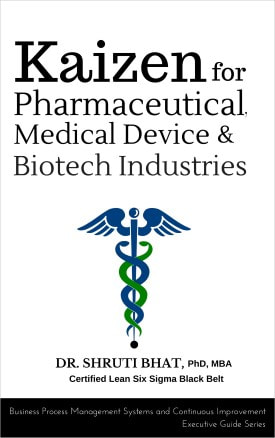
    kaizen for pharmaceutcials, medical devices and biotech industry book by Dr Shruti Bhat
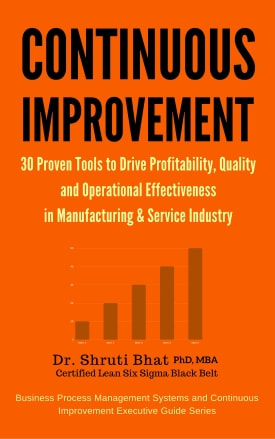
    Book on Continuous improvement tools by Dr Shruti Bhat
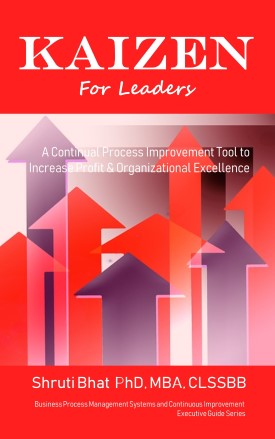
    kaizen for leaders, continuous process improvement tool to increase profit and organizational excellence by shruti bhat
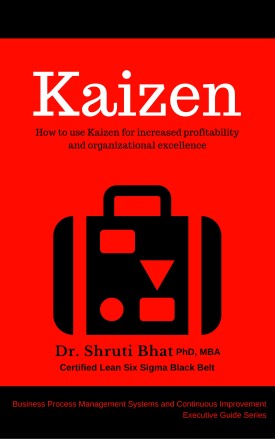
    kaizen, shruti bhat, continuous improvement, quality, operations management
    how to lead a successful business transformation
    leading organizations through crisis
    emotional intelligence
    how to overcome challenges of creating effective teams
    modular kaizen Vs Blitz kaizen
    How to increase employee engagement as a new boss

Connect with Dr. Shruti Bhat at- ​YouTube, LinkedIn​ and X

© Copyright 1992- 2026 Dr. Shruti Bhat ALL RIGHTS RESERVED.
See Terms and Conditions details for this site usage.
Picture
Subscribe to PharmaOps Consulting YouTube Channel
Subscribe to Operational Excellence Academy YouTube Channel
​Subscribe to Operational Excellence Academy YouTube Channel
SHRUTI BHAT, CONTACT
Click to connect.
Disclaimer:
  • All content (and in all formats) provided on this site is for educational purposes only. It does not constitute legal, regulatory, quality, financial, medical or professional advice. If you wish to apply ideas contained on this site, web pages, resources bank, tools and/or blog; collectively referred to as website, you are taking full responsibility for your actions. 
  • No professional-client relationship is created by reading or using this content. 
  • ​To the fullest extent permitted by law, the author(s), Dr. Shruti Bhat and website owner disclaim liability for any loss or damage arising from reliance on the information contained herein. Read full disclaimer here before reviewing the site.
Created by Macro2Micro Media