Shruti Bhat PhD, MBA, Operations Excellence Expert
  • Home
  • Operational Excellence
  • Business Continuity
  • Case Studies
  • Books
  • Insights
  • Engage Shruti
    • PharmaOps Consulting
    • Tara LeanWorks
    • Training Services
  • Blog
  • Whitepapers
  • Checklists and Templates
  • Free eBooks
  • Videos
  • Articles
    • Process Improvement
    • Business Transformation
    • Innovation Management
    • Leading Research and Development
    • Developer's Diary
    • Change Management
    • Digital Transformation
    • Quality Improvement
  • About Shruti
  • Contact

How to transform businesses via portfolio management- Part 1

4/27/2022

0 Comments

 
Transforming organizations in this era of post Covid-19 induced crisis features on 'To-Do' list of every business leader. ​
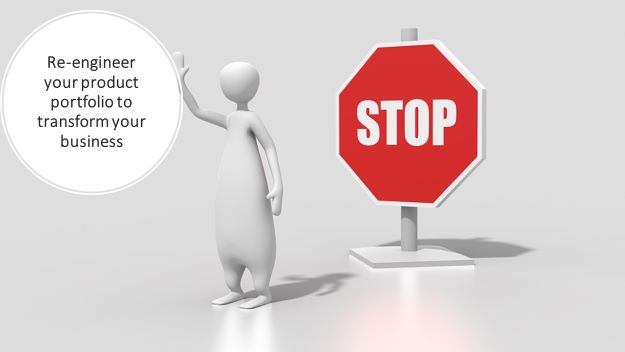
reengineer your product portfolio to transform your business
The magnitude and extent of the transformation task will be different depending on the organization’s size, industry sector, market demographics, product mix etc.

​
​Product mix or product portfolio is one of the important parameters impacting successful business transformation. 
​If you run a company that is facing a challenge to thrive in these difficult times, I would suggest that you please revisit your product portfolio in order to bring a quick turnaround.
In this blog article, I shall briefly touch upon how to bring about business transformation by building a profitable product portfolio.

Simply put, a profitable product portfolio is built on four pillars-
​
  1. Company’s definition of a new product.
  2. Portfolio project management technique employed.
  3. Product development pathway.
  4. Marketing and Sales process's ability to gain market share.

Note that the above four parameters are inter-dependent, meaning any change in one parameter will have a direct synchronistic impact on the other three, which in turn directly impacts revenue gains.

So, without further ado, let us delve into them one-by-one…

1.  Company’s definition of a new product:
The meaning of ‘new’ product is different for different organizations. Even within the same industry sector, what comprises a new product is different for different companies. Therefore, to build a profitable product portfolio, it is vital that each company clearly mentions what comprises a ‘new’ product for that company.

The path to building a successful product portfolio commences with defining what constitutes a ‘new’ product for the organization.

Broadly stating (regardless of industry sector), companies classify a new product into following nine categories-
  1. The product has at least one unique selling point (USP) such as- new technology, new use, un-met customer need, better shelf-life etc.
  2. Product is handled by a new SKU or has a new bar code.
  3. Product is new to the world.
  4. Product is new to the company.
  5. Product is new to the company’s market.
  6. Repositioned product viz. new applications for existing product or re-targeting an old product to a new market.
  7. Cost-reduced (existing) product.
  8. Improvements & modifications to existing product, including line extensions.
  9. Patentable product.

Categories 1 to 8 are pretty much self-explanatory, so I shall head straight to category 9- Patentable product.

A patentable product as the name suggests, is an item that can be patented, where the item can be a product, process or a design.

A likely question is- What’s so special about patentable products? Well, it is special because a patent offers monopoly to the patent owner. The patent term is usually up to 20 years. Also, patented products can get marketing exclusivity from 3 to 20 years depending on product type, industry sector etc.

So, if the marketing exclusivity tenure is same as the patent term, it means that there will be no competitor to worry about for twenty years!

Having said that, it must be noted that once exclusivity term ends, generic competitors can pitch-in. Hence stronger the originator patent, difficult it will be for the generics to enter the market. Further, note that all new products cannot be patented, because patentability is established when a product, process or design meets patent eligibility criteria set out by the Patent Act of the country in which the product is sold.

Therefore, more the number of patented products in your product portfolio, faster & higher will be the ROI.

Moreover, the product portfolio is always a mix, meaning products belonging to two or more of above- referred categories are present in the portfolio. Depending on the category of the ‘new’ product, it will require resource inputs such as- budget, talent pool, development time etc.

Hence, a strategic selection and right mix of new products will determine a business’s resilience to thrive through difficult times. It will also determine the extent of success with business transformation of struggling companies.

Note that, the goal of portfolio management is to reduce complexity and identify product differentiation characteristic which offers ‘value’ to the customer. This is more so when organizations face crisis conditions such as material shortages, delays due to supply chain disruptions, pandemics etc.

By adding the right transformation tools and processes, companies can actively shape a simple, value-based and profitable product portfolio that can both reduce the burden of risk management now and better serve customers once the crisis eases.
​
In the upcoming parts of this article, I shall discuss on the remaining three portfolio parameters impacting successful business transformations and how to go about positively transforming your business.
Get In Touch
Follow Shruti on Twitter, YouTube, LinkedIn

Related reading:

  1. How to transform businesses via portfolio management - Part 2
  2. How to transform businesses via portfolio management- Part 3
  3. How to transform businesses via portfolio management- Part 4
  4. How to cut costs strategically using Kaizen
  5. Idea Management: Master key to innovate and capture profit.
  6. Streamline processes and workflows with Gemba Walk
Keywords and Tags:
​
#businesstransformation #businessturnaround #strugglingcompany #sickunit #portfoliomanagement #continuousimprovement #businessprocessimprovement #processreengineering #processimprovement #processefficiencyimprovement #processeffectiveness #transformingorganizations #transformingbusinesses #newproductportfolio #howtodobusinesstransformation #howtoimprovebusinessefficiency 
0 Comments

FAQ 14- What is the biggest challenge to applying Six Sigma in the Service industry? Does Six Sigma compulsorily demand achieving 3.6 million or lesser defects per million opportunities (dpmo)?

10/18/2021

0 Comments

 
This multi-part blogpost series presents practical answers to frequently asked questions on improving business entities. 
frequently asked questions on continuous improvement
Its objective is to assist business leaders in these trying times, whether they are learning the basics of business process improvement, planning their first business improvement project, or evangelizing process-oriented thinking throughout their organization.
 
So, let’s get started …
 
Six Sigma can be applied to service industry. Though, variety of engagements faced by service firms makes it more difficult to apply Six Sigma. Yet Six Sigma methodology has been successfully applied in service sectors be it airlines, health care, banking, restaurant chains, IT, call center management, etc.
 
One of the biggest challenges to applying Six Sigma in a service industry is high number of variations than a standard product manufacturing process. This is because, service quality is ‘perceived’ by an individual, as against ‘use’ of a standard product.
 
One may not require applying all Six Sigma tools to all service process. For example Minitab application is un-necessary for a service process improvement. However, the general concept of Six Sigma can certainly be applied successfully.
 
Hence, metrics score of 3.6 million or lesser defects per million opportunities is efficiently achievable for manufacturing processes rather than service processes.
 
In addition, the return on investment (ROI) achieved from a Six Sigma service process, usually, has been found not worth the input cost for the transformation.
 
Service industries usually aim lower than 3.6 million dpmo metric score. The Cost–Need quotient is often evaluated prior to rebalancing the existing process to a 3.6 million dpmo level.
 
To clarify this point, let me take example of two important processes within Air transportation service industry- the first one is, landing gear assembly-operation for planes, while second one, is correct passenger bag arrivals at destination, on time.
 
The first process has to be a complete Six Sigma process i.e. with less than or equal to 3.6 million dpmo score, since, any failure of landing-gear operations can result in a plane crash catastrophe!
 
As regards the second process- i.e. passenger bag arrivals, one needs to check out what is the level of existing process on a sigma scale. Then calculate costs involved for transformation, its impact on business, potential loss of business due to unsatisfied customers, etc. and decide appropriately. Usually airlines follow 3- sigma level for baggage handling processes.
 
In my decade-long experience as a successful Continuous Improvement consultant, Lean Six Sigma methodology (instead of Six Sigma) works best in the service industry, showing great results, from doing the basics right, as well as cutting down waste and variations in the end-to-end process.
 
Check out more about Six Sigma, Lean Six Sigma and eighteen different business process improvement techniques here.
 
I shall discuss more FAQs concerning effective & efficient business process improvement in upcoming parts of this blog post series...
 
By the way, if you run a company that is facing a challenge to thrive in these difficult times, I would suggest that you please revisit your business processes in order to accelerate growth and bring a quick turnaround.
Get In Touch
Follow Shruti on Twitter, Facebook, YouTube, LinkedIn

Related reading:

  1. Kaizen for pharmaceutical, medical device and biotech industries.
  2. Business process improvement techniques for manufacturing and service industries.
  3. How to choose a business process improvement technique for your organization.
  4. 30 Popular continuous improvement tools.​ 
  5. YouTube #Shorts videos on Continuous Improvement.
Keywords and Tags:
​
#businessprocessimprovement #sixsigmamethodology #whatissixsigmamethdology #sixsigmaexplained #sixsigma
#businessprocessmodification #businessprocessreengineering #processimprovement #continuousimprovement    #Japanesecontinuousimprovement  #businesstransformation #businessturnaround
0 Comments

FAQ 12- What is Six Sigma methodology? Is Six Sigma the ultimate continuous improvement methodology?

10/7/2021

0 Comments

 
​This multi-part blogpost series presents practical answers to frequently asked questions on improving business entities. 
frequently asked questions on continuous improvement
Its objective is to assist business leaders in these trying times, whether they are learning the basics of business process improvement, planning their first business improvement project, or evangelizing process-oriented thinking throughout their organization.
 
So, let’s get started …
 
At the outset, there is no ultimate business improvement or continuous improvement methodology. Please do not waste your time to search for one.
 
Over the years, several business process improvement methodologies have been suggested and successfully applied to various industry sectors.

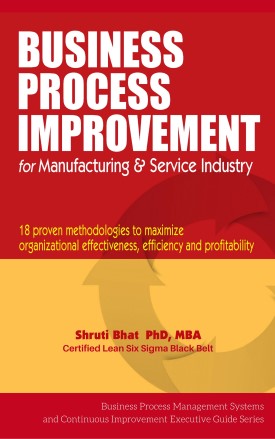
Eighteen such continuous improvement methodologies applicable to manufacturing and service sectors are explained in my book entitled ‘Business Process Improvement for Manufacturing and Service Industry’. Check it out here-https://www.amazon.com/Business-Process-Improvement-Manufacturing-Industry/dp/1988663075/ref=sr_1_1?ie=UTF8&qid=1503707949&sr=8-1&keywords=shruti+bhat
 
Built upon each other, these methodologies often employ common tools for problem solving. They represent the experiences and thoughts about process improvement by workers, managers, consultants, and scholars throughout the entire industrial age. They are still evolving today, as more and more organizations have started to implement them.
 
The Six Sigma process improvement methodology was developed in Motorola company around 1986. Their aim was to improve processes, minimize variations and eliminate defects from their operations and products.
 
As much as 3.6 million defects are reduced per million opportunities in a Six Sigma process. The number of defects decrease further as the ‘sigma’ level of the process increases. But so will the cost of running operations.
 
Usually a mix of 3-sigma and 6-sigma processes give optimal rewards.
 
Also, combining Six Sigma with other process improvement techniques such as Lean, Kaizen, Agile or Hoshin further improves process efficiency and reduces operational cost.
 
But no matter what the process improvement methodology or what benefits it claims to generate, it can never be the only solution to improve organizational performance. In fact, over-commitment to it can actually weaken an organization’s competitive advantage. And it is advisable to combine two to three process improvement methodologies to achieve best rewards.
 
To grow, an organization must balance process improvement with other initiatives such as innovation, improved product/ service features, employee development.
 
Although process improvement can improve lead-time, productivity, inventories, cost, and quality, it can never replace an innovative product.
 
In other words, a new product needed and wanted by customers will generate a dramatic demand in the marketplace that the organization can succeed even without process improvement. Having said that, if such a customer-centric innovative company were to follow process improvement techniques, it would augment its profits exponentially.
 
Similarly, process improvement methodologies can never replace commitment of competent employees. When innovative and job-trained employees of an organization are committed, they will improve the processes even without any formal process improvement initiatives.
 
Hence, I iterate that none of the process improvement methods, including Six Sigma is ultimate. You must select the methodology best suited for your workplace. Check out more about how to choose a business process improvement methodology for your organization here.
  
I shall discuss more FAQs concerning effective & efficient business process improvement in upcoming parts of this blog post series...
 
By the way, if you run a company that is facing a challenge to thrive in these difficult times, I would suggest that you please revisit your business processes in order to accelerate growth and bring a quick turnaround.
Get In Touch
Follow Shruti on Twitter, Facebook, YouTube, LinkedIn

Related reading:

  1. Kaizen for pharmaceutical, medical device and biotech industries.
  2. Business process improvement techniques for manufacturing and service industries.
  3. How to choose a business process improvement technique for your organization.
  4. 30 Popular continuous improvement tools.​ 
  5. YouTube #Shorts videos on Continuous Improvement.
Keywords and Tags:

#businessprocessimprovement #sixsigmaexplained #whatissixsigma #whatissixsigmamethodology #sixsigma #sixsigmacontinuousimprovement #sixsigmamemoryjogger #processimprovement #continuousimprovement   #howtousesixsigmamethodology #businessprocessmodification #businessprocessreengineering     #strategicplanning   #strategymanagement  
0 Comments

What are the core success factors to transform business organizations?

10/3/2021

0 Comments

 
As leaders around the world steer their organizations out of the pandemic, many are recognizing the need for transformation. 
what are the core success factors to transform business organizations
Some are trying to reimagine their cost structure to compete, while others are needing to reimagine their entire business model in the face of rapid industry change.

A recently published research study revealed that 3 out 4 transformations fail; meaning the success rate of business transformation is only 25%. So, the obvious question is- How to beat these transformation odds?

Here are four core factors for a successful business transformation-

1. Comprehensive scope & cross-functional initiatives-
The transformation campaign must be strategic, intense, and a well-managed program to enhance organizational performance and boost business resilience.
 
Further, the scope of business transformation must cut across all functions (of the organization) that impact the business’s topline, bottom line and engage a substantial quantum of workforce.

​Tip: Checkout more about workforce engagement here.

2. Cashflow management:
It has been found that forty percent of successful business transformation comes from growth initiatives.

However, what goes unmeasured or superficially measured, risks being mismanaged or even under-managed. Hence, growth initiatives must be measured periodically to guarantee success with business transformations.
 
Several metrics are available to measure organizational growth. However, I’ve found monthly cashflow management as the most powerful metric for measuring growth and the organization’s overall health.
 
In addition, optimal cashflow facilitates achievement of larger financial objectives. In fact, cashflow management increases the success rate of business transformation by 130 times.

3. Goal:
Business transformation is a marathon not a sprint. 

Done right, full business transformation can take from nine to eighteen months or more, depending on the size of the organization, countries of business operations, product mix, work culture, employee base and transformation strategy.

Broadly there are three types of transformation- Breakthrough transformation, Streamlined transformation and Incremental transformation. And the strategy must be designed accordingly. To know more about these three types of organizational transformations check here.
 
​For successful transformations, it is vital to step outside of self-imposed constraints and define what’s truly achievable (i.e. the goal) and then go after it with full steam.
 
I recommend setting a business transformation target of 75% (instead of 100%) at the outset because it increases chances of success. This goal must then be smartly stretched higher as the business witnesses the fruits of change.

4. Speed:
Quick wins fund long-term business transformation ambitions.
 
Therefore, value stream mapping and identifying low hanging fruits is key. This entails selecting business processes that are easy to improve and have a high positive impact on the topline and bottom line.
 
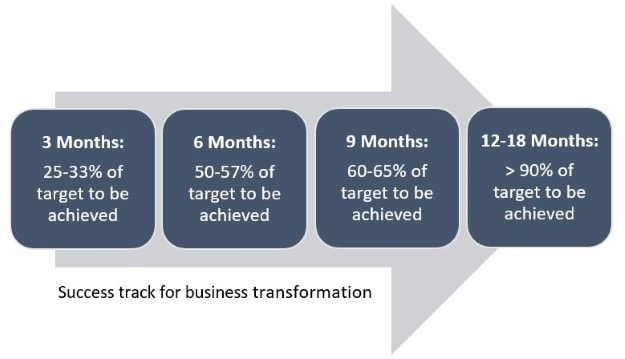
In my decade-long experience as a business transformation expert, I’ve found that successful transformation follows a trajectory. Here’s one such example of business transformation success track-
success track for business transformation
​Tip: Note that this success track depends on the organization’s size, culture, product portfolio and condition of business.
 
A quick sprint at the start motivates stakeholders, employees and boosts the business transformation campaign mojo.

Besides the above four core factors, a focus on communication, leading by example, engaging employees and continuous improvement can triple the odds of success. 

Moreover, the culture of continuous improvement keeps the organizational performance from stagnating (or even regressing) once transformation goals are met.
​
Are you planning to install a culture of continuous improvement at your workplace?
Get In Touch
Follow Shruti on Twitter, Facebook, YouTube, LinkedIn

Related reading:

  1. How to transform businesses via portfolio management- Part 1
  2. How to transform businesses via portfolio management - Part 2
  3. How to transform businesses via portfolio management- Part 3
  4. How to transform businesses via portfolio management- Part 4
  5. How to cut costs strategically using Kaizen
Keywords and Tags:

​#businesstransformation #businessturnaround #continuousimprovement  #howtotransformbusiness  #sucessfactorsofbusinesstransformation 
0 Comments

FAQ 11- What is meant by the term cost of quality? How to reduce cost of quality?

9/27/2021

0 Comments

 
​This multi-part blogpost series presents practical answers to frequently asked questions on improving business entities. 
frequently asked questions on continuous improvement
Its objective is to assist business leaders in these trying times, whether they are learning the basics of business process improvement, planning their first business improvement project, or evangelizing process-oriented thinking throughout their organization.
 
So, let’s get started … 
 
Cost of Quality refers to the entire sum that takes to produce a product or service while guaranteeing high standards of quality. This encompasses conformance as well as non-conformance costs, such as- costs allocated to repeat work, errors, and defects. For example, in the manufacturing industry, cost of quality can be increased by situations such as returned goods items.
 
There are a few different opinions that professional’s debate regarding Cost of Quality.
 
Few opine that, increased quality means increased cost. Enhancing features that relate to quality, such as performance and procedures, require more money for designing, sourcing materials, using labor and various other resources that add up significantly. Sometimes the added bonuses of quality improvement do not make up for the extra expenses.
 
Another opinion is that it costs less to improve quality of a product or service than it does to deal with the defects. Companies save more money since they do not have to spend it unnecessarily on costs that directly relate to defects. This concept is very popular among Japanese manufacturers.
 
Another popular opinion regarding Cost of Quality is that costs would be less if, a product or service were created in the optimal way right from start. This includes losses such as hidden expenses and missed opportunities.
 
Irrespective of the different Cost of Quality concepts, the criteria used to judge it remains the same, namely: production cost, internal and external failure cost, defect prevention cost, opportunity cost and inspection cost.
 
Internal failure cost refers to expenses incurred from defects found prior to reaching the customer and includes reviews, re-inspection, revision, and rework.
 
External failure cost refers to expenses involved with defects found once the product has reached hands of the customer and includes costs of product recalls, returns and warranty claims.
 
Prevention costs refer to the costs related to deterrence of quality that is lacking, such as training, reviewing and planning.
 
Inspection costs occur during the time that it takes to find out if a product or service fulfills the standard of quality that is required through testing and evaluation.
 
Therefore, lower the cost of quality, higher is the profit.
 
Hence, all technical and business processes undermining cost of quality must be regularly studied, improved or redesigned to make the business more efficient and profitable. This can be done by installing a culture of continuous improvement in your organization. 

​There are more than eighteen different business process improvement techniques. Check them out here.
 
I shall discuss more FAQs concerning effective & efficient business process improvement in upcoming parts of this blog post series...
 
By the way, if you run a company that is facing a challenge to thrive in these difficult times, I would suggest that you please revisit your business processes in order to accelerate growth and bring a quick turnaround.
Get In Touch
Follow Shruti on Twitter, Facebook, YouTube, LinkedIn

Related reading:

  1. Kaizen for pharmaceutical, medical device and biotech industries.
  2. Business process improvement techniques for manufacturing and service industries.
  3. How to choose a business process improvement technique for your organization.
  4. 30 Popular continuous improvement tools.​ 
  5. YouTube #Shorts videos on Continuous Improvement.
Keywords and Tags:

#businessprocessimprovement #QMS #howtoimprovequality #whatiscostofquality #howtoreducebusinesscost #costofquality #howtoreducecostofquality #costofqualityexplained #strategicplanning #processimprovement #qualitymanagementsystems #strategymanagement #qualitymanagement #continuousimprovement  #businessprocessmodification   #businessprocessreengineering 
0 Comments

FAQ 10- Classically, Pareto’s 80/20 rule has been applied in time management. What is Pareto’s BPM methodology?

9/20/2021

0 Comments

 
This multi-part blog post series presents practical answers to frequently asked questions on improving business entities. 
frequently asked questions on continuous improvement
Its objective is to assist business leaders in these trying times, whether they are learning the basics of business process improvement, planning their first business improvement project, or evangelizing process-oriented thinking throughout their organization.
 
So, let’s get started…
 
Business process management is management of various activities involved in an organization, such as- identification, evaluation and improvement in various processes of a business.
 
Businesses tend to use this action in order to assess and increase productivity, business efficiency, sales, customer satisfaction and overall business performance.
 
Pareto’s 80/20 business process management (BPM) methodology suggests that 20 % of managed activities should bring forth 80% of beneficial results.
 
While there are several advantages of Pareto’s 80/20 BPM methodology, there are few potential challenges too, for example - its sustainability.
 
If a business’s revenue or profit heavily relies on specific clients, then their decisions will have a huge impact on the business’s value. This can be especially harmful if the business relies on a small group of individuals as ‘clients’. In case of loss of a single client, business income and profit could take a giant blow.
 
The way to solve this issue is to find ways of making profit away from the group.
 
Categorizing the top clients and finding attributes that they all have in common is a sure way to mitigate risks. It will then be easier to look for clients that fit the same format.  Higher the number of individuals making up ‘important client’ list the better.
 
Another challenge with Pareto’s 80/20 rule is that it can be difficult for companies to know when they should apply the rule, and when not.
 
Pareto’s 80/20 rule can also be a drawback for a company’s workflow. While it is meant to eliminate activities that waste time and draw focus to the real goals, implementing the rule could just get in the way of methods that are already functioning effectively.
 
Check out more about Pareto 80/20 rule and eighteen different business process improvement techniques here.
 
I shall discuss more FAQs concerning effective & efficient business process improvement in the upcoming parts of this blog series ...
 
By the way, if you run a company that is facing a challenge to thrive in these difficult times, I would suggest that you please revisit your business processes in order to accelerate growth and bring a quick turnaround.
Get In Touch
Follow Shruti on Twitter, Facebook, YouTube, LinkedIn

Related reading:

  1. ​​Kaizen for pharmaceutical, medical device and biotech industries.
  2. Business process improvement techniques for manufacturing and service industries.
  3. How to choose a business process improvement technique for your organization.
  4. 30 Popular continuous improvement tools.​ 
  5. YouTube #Shorts videos on Continuous Improvement.
Keywords and Tags:

#businessprocessimprovement #pareto8020rule #paretorule #paretobusinessprocessimprovementmethodology  #paretobpm #paretobusinessprocessmanagement   
#businessprocessmodification #businessprocessreengineering #processimprovement #continuousimprovement   #strategicplanning  #strategymanagement #businessturnaround
#advantagesandisadvantagesofparetorule
0 Comments

FAQ 8- Hoshin Kanri is very popular within auto, dairy, banking and financial industries because of the benefits it offers with strategic planning and management. Can Hoshin Kanri methodology be applied to other organizations? Could you briefly explain H

9/10/2021

0 Comments

 
​This multi-part blog post series presents practical answers to frequently asked questions on improving business entities. 
frequently asked questions on continuous improvement
​Its objective is to assist business leaders in these trying times, whether they are learning the basics of business process improvement, planning their first business improvement project, or evangelizing process-oriented thinking throughout their organization.
 
So, let’s get started…
 
Hoshin Kanri is a strategic planning, design or strategic management philosophy first developed in Japan by Professor Yoji Akao after the world war around 1950s.
 
Hoshin Kanrii are two Japanese words. Hoshin means ‘direction or compass needle’, while Kanri means ‘control or management’.
 
Together Hoshin Kanri is a business process improvement technique. The principle of this technique is to let the strategic goals of the organization guide every decision and action in the company.
 
Hoshin Kanri, usually called as Hoshin, is a top-down business improvement methodology. Hoshin empowers employees and total quality management of products and processes.
 
Hoshin principle believes that each individual working in the company is an ‘Expert’ in his/her own job and together such an ‘expert work force’ delivers quality-based products/ services to the customers.
 
Like all continuous improvement methodologies, Hoshin too has its set of dos and don’ts.
 
Some of the Hoshin dos are-
 
In order to achieve success with Hoshin Kanri implementation, a company should set clear and measurable goals, with special focus towards ‘shared goals’.
 
Also, job train employees to ensure that they build on-the-job ‘expertise’. Have a sound communication and social engineering policy in place, encourage team-building and job accountability within employees and work teams.
 
An important point to note is that, for Hoshin Kanri to benefit a company, it must be implemented firmly, sometimes to the point of being authoritative.
 
Some cultures may not be open to this type of authoritative implementation and it may end up causing stress and discomfort in the business instead of fostering motivation and enthusiasm.
 
Here are few Hoshin don’ts-
 
If quick reward is your goal, don’t consider Hoshin.
 
Because Hoshin Kanri is not a short-term project that can just be implemented for a week or two. It is a long-term mission, and requires a lot of support from top management, dedication, time, effort and patience.
 
Leaders and employees must understand that Hoshin Kanri may not appear to be beneficial for a long period initially; however, one needs to be at it with resilience, and then it begins to help the company immensely.
 
A typical Hoshin Kanri structure outlines ideas for up to five years.
 
It is common for reaching goals between three to five years on an average. During this three-year span, the core objectives of the business are expected to stay the same. This means that the procedures and processes involved in reaching the goal must remain stable. If anything causes a big change to the processes in midst of Hoshin Kanri implementation, then all the hard work, time and effort put in so far could become a waste.
 
Without a clear understanding on the long-term goals, many employees will lose sight of the goal and start to lose motivation. Therefore, employees must be continuously reminded about their importance in the Hoshin based continuous improvement process in order to keep motivation high throughout the long period of Hoshin Kanri implementation.
 
Like all business improvement methods, Hoshin Kanri requires frequent evaluation and control in order to ensure that everything is working out as it should. Check out more about Hoshin Kanrii and eighteen different business process improvement techniques here.
 
I shall discuss more FAQs concerning effective & efficient business process improvement in upcoming parts of this blog post series...
 
By the way, if you run a company that is facing a challenge to thrive in these difficult times, I would suggest that you please revisit your business processes in order to accelerate growth and bring a quick turnaround.
Get In Touch
Follow Shruti on Twitter, Facebook, YouTube, LinkedIn

Related reading:

  1. Kaizen for pharmaceutical, medical device and biotech industries.
  2. Business process improvement techniques for manufacturing and service industries.
  3. How to choose a business process improvement technique for your organization.
  4. 30 Popular continuous improvement tools.​ 
  5. YouTube #Shorts videos on Continuous Improvement.
Keywords and Tags:
#businessprocessimprovement  #HoshinKanri #hoshinkanrimethodology #hoshinkanrii  #HoshinKanriexplained #whatishoshinkanri #businessprocessmodification #businessprocessreengineering #processimprovement #continuousimprovement  #hoshinkanrimemoryjogger  #Japanesecontinuousimprovement  #strategicplanning  #strategymanagement​
0 Comments
<<Previous
Forward>>

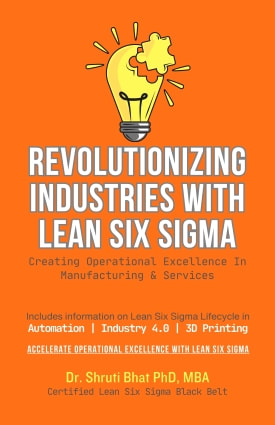
    New Book Released!

    Revolutionizing Industries with Lean Six Sigma

    Shruti's YouTube Channel ...

    Picture

    Blog Categories

    All
    3D Printing
    Agile
    Artificial Intelligence
    Automation
    Biotechnology
    Books
    Business Continuity
    Business Turnaround
    Case Studies
    Change Management
    Checklists
    Chemical Industry
    Continuous Improvement
    Design Thinking
    Digitalization
    Drug Delivery
    External News Links
    Hall Of Fame
    Healthcare
    Hoshin Kanri
    HR Development
    Innovation
    Insights
    ISO
    Just In Time
    Kaizen
    Leadership
    LEAN
    Lean Six Sigma
    Life Sciences
    Machine Learning
    Manufacturing
    Medical Devices
    Mistake Proofing
    Motivational Cards
    MSMEs
    Nanotechnology
    Operational Excellence
    Packaging
    Patents
    Personal Products
    Process Improvement
    Product Development
    Productivity Increase
    QbD
    Quality Management
    R&D Leadership
    Robotics
    Service Industry
    Six Sigma
    Strategy
    Supply Chain Logistics
    Telecom Industry
    Templates
    TQM
    Videos
    Voice Of Customer
    Whitepaper
    Workshops

    Shruti's books...

    Picture
    top ten strategic decision-making tools for operational excellence
    shruti bhat, business process management, continuous improvement
    kaizen for pharmaceutcials, medical devices and biotech industry book by Dr Shruti Bhat
    Book on Continuous improvement tools by Dr Shruti Bhat
    kaizen for leaders, continuous process improvement tool to increase profit and organizational excellence by shruti bhat
    kaizen, shruti bhat, continuous improvement, quality, operations management
    how to lead a successful business transformation
    leading organizations through crisis
    emotional intelligence
    how to overcome challenges of creating effective teams
    modular kaizen Vs Blitz kaizen
    How to increase employee engagement as a new boss

Connect with Dr. Shruti Bhat at- ​YouTube, LinkedIn​ and X

© Copyright 1992- 2026 Dr. Shruti Bhat ALL RIGHTS RESERVED.
See Terms and Conditions for details on this site usage.
Picture
Subscribe to PharmaOps Consulting YouTube Channel
Subscribe to Operational Excellence Academy YouTube Channel
​Subscribe to Operational Excellence Academy YouTube Channel
SHRUTI BHAT, CONTACT
Click to connect.
Created by Macro2Micro Media